UV sterilizer for well water
A UV sterilizer is the last stage of a well-water treatment train, not the first. Ultraviolet light inactivates bacteria and other micro-organisms as water passes the lamp — but it does nothing about turbidity, iron, manganese, hardness, nitrate or hydrogen sulfide, and several of those will stop a UV unit from working at all. The unit described here is an in-line post-treatment component: it is installed on a line that already delivers filtered water, and its feed-water limits are part of its warranty conditions.
Not sure what is in the water yet?
Start with the test, not the equipment — how to make well water safe to drink.
Is UV enough on its own?
Short answer: no. What UV does and does not do.

The unit is the same in all three cases. In all three it is a post-treatment component — the water reaching it has already been treated, and in the well-water case that has to be arranged before the unit is installed, not after.
This unit is an in-line UV post-treatment component for RO and under-sink systems. It is not a stand-alone water purifier, and it removes nothing dissolved — filtration happens upstream of it.
Why well water needs a different treatment train
A public supply arrives already treated, already monitored and already disinfected. A private well arrives as it comes out of the ground — and in the United States, a private well serving a single household is not regulated as a public water system. There is no utility responsible for testing it and no disinfection residual maintained in it. Whatever treatment exists, the owner specifies and the owner maintains.
That changes the order of operations. On a municipal supply you can add a sterilizer at the tap and be done. On a well, the water itself has to be brought into specification first, because the contaminants that make well water unpleasant are frequently the same ones that make UV treatment ineffective.
| Aspect | Public supply | Private well |
|---|---|---|
| Responsibility for testing | The utility, under drinking-water regulation | The owner. Testing frequency is a decision, not a schedule imposed from outside |
| Disinfectant residual | Maintained through the distribution system | None. Nothing downstream of the wellhead suppresses regrowth |
| Typical problems | Corrosion, disinfection by-products, line replacement | Bacteria, iron, manganese, hardness, nitrate, sulfide, seasonal variation |
| Where a UV unit fits | Point of use, on filtered water | Point of use, on filtered water — and only after the water is in specification |
Three gates the water has to pass before a UV unit is the right answer
Ultraviolet treatment works by delivering dose — lamp intensity multiplied by contact time. Anything in the water that absorbs, scatters or shields that light reduces the dose the micro-organisms actually receive. That is why a UV unit sold for well water carries feed-water limits, and why installing one on raw well water is a common and expensive mistake.
1 · Turbidity and suspended solids
Cloudy water shields micro-organisms from the lamp. A particle can carry bacteria through the chamber in its shadow, untouched. Sediment filtration comes first.
2 · Iron and manganese
Dissolved iron oxidises into deposits that stain the quartz sleeve — the surface the light has to pass through. Deposits cut UV transmission long before the lamp reaches end of life.
3 · Hardness
Scale forms on the same sleeve, at the same place, for the same reason. Hardness is not a health issue, but it is a maintenance issue that shortens effective service.
The unit described on this site is specified for water at turbidity below 1.0 NTU, iron below 0.3 ppm, hardness below 120 ppm, pH 4–8 and chlorine at or below 1.0 mg/L. Those figures are not marketing targets — they are the conditions under which the declared performance and the warranty apply. Raw well water frequently fails at least one of them, which is precisely why the answer to "can I just fit a UV unit to my well?" is usually "not yet".
If your test report shows iron, manganese or hardness above those figures, the UV stage is still viable — it simply sits after the stage that fixes them. The sequence matters more than any single component.
Where the unit sits in a well-water train
The general order for a well supply is: well pump → pressure tank → sediment and iron removal → (softening, if needed) → UV sterilizer → point of use. Everything downstream of the lamp should be as short as possible, because that is the only part of the system with nothing left to suppress regrowth.
- Test first. The test result decides which stages exist at all. A well with clear water and low iron needs a shorter train than one with iron bacteria.
- Remove what the lamp cannot handle. Sediment filtration for turbidity; oxidation and filtration for iron and manganese; softening for hardness where scale matters.
- Place the sterilizer last. After the pressure tank and after the treatment stages — on the line that feeds the point of use, not on the raw line from the wellhead.
- Keep the run short. Tubing and fittings downstream of the lamp are the surfaces where a biofilm can re-establish. Fewer inches of pipe is a design choice.
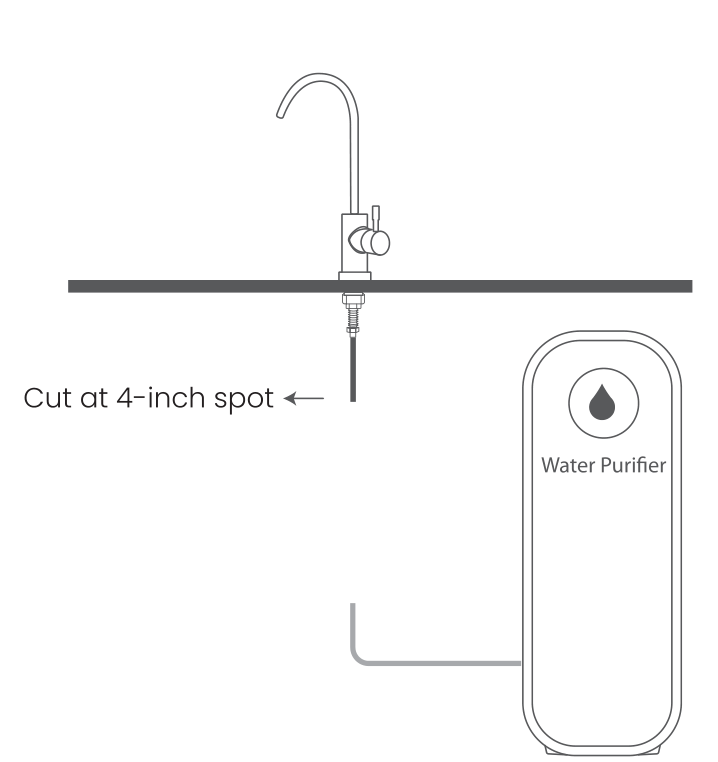
The inlet takes water from the treated side and the outlet feeds the point of use. Flow direction is marked on the housing and the two ends are not interchangeable. The unit is held on the treated line by a pipe clamp, with the tubing run after the lamp kept as short as the installation allows.
This is a point-of-use component for a single treated line. It is not a point-of-entry treatment system for a whole property, and it is not a stand-alone water purifier — it has no filter element and removes nothing. It treats water that has already been treated.
When a UV stage earns its place — and when it does not
A UV stage is doing real work when…
- The water is already clear and low in iron, and the remaining concern is microbial
- A bacteriological test has come back positive and the source cannot be sealed or re-grouted
- A storage tank, pressure tank or long run of pipe sits between treatment and the tap
- The supply is intermittent, seasonal, or shared with irrigation or livestock
- Chemical disinfection is unwanted downstream — no chlorine residual in the drinking water
A UV stage solves nothing when…
- The complaint is taste or odour — UV does not change dissolved gases
- The complaint is staining — iron and manganese need oxidation and filtration
- Nitrate or arsenic is the finding — UV does not remove either
- The water is cloudy or visibly dirty — turbidity has to be fixed first
- Water is drawn directly from the wellhead with no pre-treatment at all
The hardware, and what it needs from the water
| Model | Rated flow | Fitting | Typical fit |
|---|---|---|---|
| ZXSJ-UVC-1GPM | 1 GPM (4 LPM) | 1/4" | Single-outlet point of use, standard under-sink tubing |
| ZXSJ-UVC-3GPM | 3 GPM (11.4 LPM) | 3/8" | Higher draw at the outlet, or several fixtures on the same treated line |
| Feed water pressure | ≥ 14.5 psi and ≤ 60 psi (0.1–0.4 MPa) |
|---|---|
| Inlet water temperature | 32–100 °F (0–37.8 °C) — cold water only |
| Turbidity | < 1.0 NTU |
| Maximum iron | < 0.3 ppm |
| Maximum hardness | < 120 ppm |
| Chlorine concentration | ≤ 1.0 mg/L |
| pH | 4 – 8 |
| Water use | Drinking water supply only — water must be pre-filtered |
The UVC-LED rated life of 15,000 hours is the manufacturer's design rating, stated with an output criterion of not less than 60% of initial output. It is not a validated service-life claim. In a point-of-use installation the lamp runs only while water is flowing, so the practical service interval is more often set by what deposits on the quartz sleeve than by the emitter itself.
Well water and UV
Can I put a UV sterilizer directly on well water?
Not on untreated well water. A UV unit needs the water to be clear, low in iron and within a stated pH and hardness range, because anything that shields or deposits on the lamp path reduces the dose delivered. Raw well water often fails at least one of those conditions, so the unit is installed after filtration — not instead of it.
Will a UV sterilizer remove iron or fix the taste?
No. UV treatment inactivates micro-organisms; it does not remove dissolved minerals or dissolved gases. Iron, manganese and hardness are removed by oxidation, filtration or softening. Sulfur odour comes from hydrogen sulfide, which is a dissolved gas — UV does not touch it, and the treatment path is aeration and oxidation followed by filtration.
Do I need a UV unit if the water tested clear for bacteria?
A single clear test is a snapshot. Private well water quality varies with rainfall, season, snowmelt and the condition of the wellhead, and a well that reads clean in a dry month can read differently after heavy rain. Whether to add disinfection is a judgement about the site and the use — a well serving one tap for drinking is a different risk profile from one feeding a household with an infant.
Does the unit need to run all the time?
It cannot. A flow sensor on the inlet detects movement when a tap opens and starts the UVC-LED; when flow stops the lamp returns to standby. There is no timer, no schedule and no manual switch. The blue ring means powered and standing by, green means the lamp is running, red means a fault.
What has to be checked routinely?
The indicator light is the routine check, and the quartz sleeve is the routine maintenance item — driven by hardness and iron in the feed water, which is why those two figures appear in the feed-water table. There is no lamp countdown to track and no scheduled lamp replacement interval.
Describe the well and the test result
The more of the train you can describe — pump, tank, filtration, and what the last test showed — the more specific the reply can be.
- Models: ZXSJ-UVC-1GPM | ZXSJ-UVC-3GPM
- Credential: CE conformity certificate DPCW/01068/06/KA/26 · EPA Establishment No. 105777-CHN-1 (facility registration)
- Feed water: pre-filtered, turbidity < 1.0 NTU, iron < 0.3 ppm, hardness < 120 ppm
- Samples: available for evaluation before a volume commitment
- OEM / ODM: fittings, cable, packaging and accessories on programme terms
Send an enquiry
Typical response within one business day.
This form is not yet connected to a mail service — the enquiry endpoint will be wired up at launch.
Sources and scope
5 sources
- Feed-water limits, model designations and declared scope of application: SKWEIT® UV Water Sterilizer instruction manual, revision 01.03, and the accompanying product parameter table. Cited for: pressure, temperature, turbidity, iron, hardness, pH and chlorine limits; flow ratings; fitting sizes.
- Rated life: manufacturer's product specification. Stated as a design rating with an output criterion of not less than 60% of initial output, not as a validated service-life claim.
- Certification references: certificate originals held by the manufacturer — CE conformity certificate DPCW/01068/06/KA/26 (INTERCERT Global, Warsaw); EPA establishment registration 105777-CHN-1 (a facility registration, not a product certification).
- Regulatory position of private wells: private wells serving a single household are not regulated as public water systems in the United States. Cited for: the statement that testing and maintenance responsibility rests with the well owner.
- Treatment sequence and placement: the manufacturer's installation documentation and published installation drawings. Cited for: cut-in position, in-line connection and flow-direction requirements.