Manufacturer: Suzhou Purple Core Instant Purification Technology Co.,Ltd. | CE: DPCW/01068/06/KA/26 | EPA Est. No. 105777-CHN-1
Solutions

Where an in-line UV stage belongs — and where it does not

An in-line ultraviolet unit is a last-stage component, not a treatment system in its own right. It is fitted on a line carrying water that has already been filtered — after an RO storage tank, on the under-sink drinking-water branch, or wherever a private well supply is drawn for the house. Because the lamp removes nothing from the water, each of the three cases below is decided by what sits in front of the unit, not by the unit itself.

Three installation cases Post-treatment, never stand-alone No residual effect — position decides
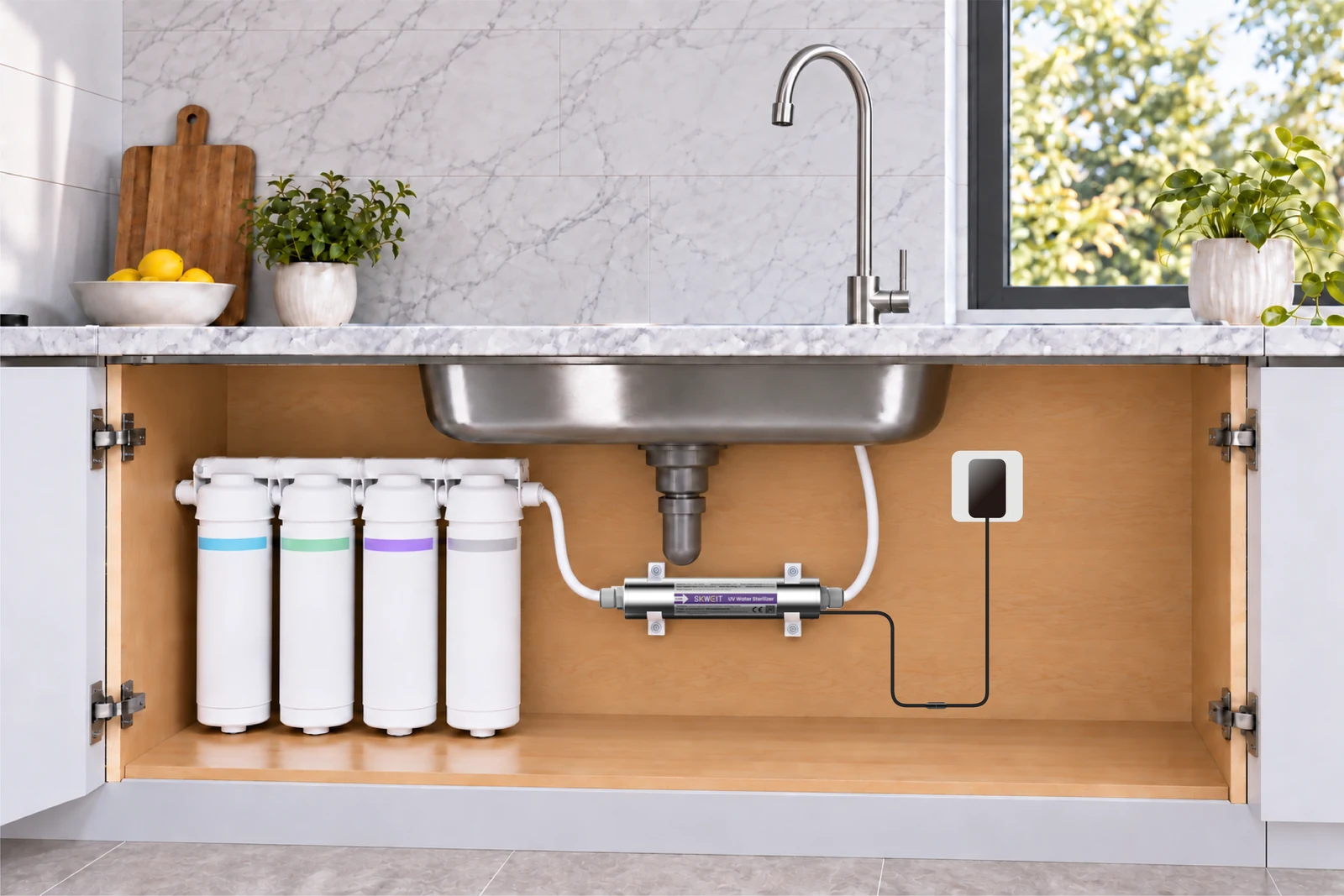
An in-line UVC unit installed under a sink on the permeate line, downstream of the RO storage tank and upstream of the faucet
Three cases

The three places an in-line stage is asked for

Each case has its own reason for existing, and each one fails for its own reason. Read the case that matches where you are working, not the one with the nearest headline.

Case 1 · Reverse osmosis systems

Retrofitting an RO system — the stage after the storage tank

An RO membrane and the tank behind it are the two places a drinking-water line is most likely to pick up bacteria again: the membrane is the last barrier, and everything downstream of it is stored, still, at ambient temperature. An in-line stage on the permeate line, after the tank and before the faucet, is the one position that closes that gap without touching the treatment the system already performs.

Post-tank, pre-faucet 1 GPM suits a single outlet
Case 2 · Under-sink drinking water

An under-sink unit on a filtered drinking-water branch

Where a dedicated drinking-water faucet is fed from a filtration set, the run from the last filter to the faucet is short and the water in it stands between draws. The constraints here are physical rather than chemical — cabinet space, tubing runs, and whether there is a power outlet inside the cabinet at all.

Cabinet-mounted Needs a nearby outlet
Case 3 · Private well supplies

A well supply, and what has to be true before UV helps

A private well is the case where an ultraviolet stage is most often specified for the wrong reason. It treats what passes the chamber; it does not remove iron, manganese, sulphur or sediment, and those are what a well supply usually carries. This page is about the order the stages have to go in.

Whole-supply point Pre-treatment decides
What it answers, what it does not

A UV stage is one line in a treatment train, not the train

Buyers arrive at ultraviolet for different reasons, and most of those reasons are not the ones ultraviolet addresses. The table below is the shortest honest answer to “would a UV stage fix this?” — the third column is the one that matters, because it names the stage that actually does the job.

An in-line UVC stage against the problems it is commonly asked about
What the water carries An in-line UV stage The stage that actually addresses it
Bacteria and viruses on the treated line This is the stage's own job: light reaching the water as it passes the chamber. Sizing is by flow and contact, not by contaminant load. Last position, after filtration and after any storage tank.
Sediment, rust and turbidity Not addressed — and this is what blinds the sleeve that the light has to pass through. Pre-filtration ahead of the unit. This is a condition of use, not an option.
Chlorine, taste and odour Not addressed. Ultraviolet is not an oxidising stage in this application. Carbon stage ahead of the unit.
Dissolved PFAS Not addressed. A UVC lamp does nothing to a dissolved fluorinated compound in the water passing it. Reverse osmosis, activated carbon or ion exchange — see the PFAS page.
Lead Not addressed. Adsorption media or reverse osmosis.
Nitrate Not addressed. Reverse osmosis or ion exchange.
Dissolved iron and manganese Not addressed. They also stain the sleeve and cut transmission. Oxidation followed by filtration, ahead of the unit.
A biofilm already established in the tank or the lines Partly. The lamp treats what passes the chamber; it does not strip a film that has already formed upstream of it. Cleaning or replacing the affected section, plus the upstream cause — see biofilm in a storage tank.
Sulphur odour Not addressed. Oxidation followed by filtration — see sulphur smell in well water.
The one thing a UV stage must never be sold as

A stand-alone water purifier. It requires pre-filtered drinking water as feed water and it is installed on a line that already exists, so every page in this section describes it as a post-treatment unit. The same reason rules out presenting one unit as treating a whole property's supply: a single unit sits at one point on one line, and saying otherwise misdescribes both the product and the job.

Position, not product

Three questions that decide the case before the model

What is the line carrying, and how much of it?

Rated flow is chosen against the draw at the point of use, not against the supply. A single drinking-water faucet and a multi-outlet draw are two different units. If the flow at the point of use is unknown, that is the first thing to measure.

What is immediately in front of the unit?

Filtration that is present, filtration that is working, and filtration that is being relied on but is overdue are three different situations. The unit inherits the result of whatever its upstream stage is passing.

Where does the water stand when nothing is running?

Between the membrane or filter and the faucet, water sits still. That standing volume is what a last-stage unit is placed to cover — which is why the position is after the tank rather than anywhere the run happens to be convenient.

Not sure which case you have

Send the line you are working on, the draw at the point of use, and what is already in front of the unit. Those three answers select the case, and the case selects the model. The product pages carry the two models; the installation guide covers the fitting sequence; the feed-water limits are the conditions the upstream system has to meet.

Describe the installation and we will answer against it

A reply is more useful when it includes the line you are working on, the draw at the point of use and what sits in front of the unit — those three decide the case and the model.

  • Models: ZXSJ-UVC-1GPM (1 GPM / 4 LPM, 1/4") | ZXSJ-UVC-3GPM (3 GPM / 11.4 LPM, 3/8")
  • Available now: instruction manual · parameter table · CE certificate DPCW/01068/06/KA/26 · EPA Establishment No. 105777-CHN-1
  • Issued per order: net weight, unit dimensions, carton data, pricing, lead time

Send an enquiry

Typical response within one business day.

This form is not yet connected to a mail service — the enquiry endpoint will be wired up at launch. Until then, write to sales@skweit.cn or through the contact page.

Scope and document control

4 sources
  1. The three cases on this page describe in-line UVC post-treatment for pre-filtered drinking water. They are not installation instructions and not a specification; the fitting sequence is in the installation guide and the published values are in the data sheet.
  2. Statements about what an ultraviolet stage does not remove are statements about the stage, not about any competing technology, and they are made because a buyer who specifies UV for a dissolved contaminant buys the wrong stage.
  3. No microbiological performance figure, log-reduction figure, UV dose value or validated service life is published anywhere in this section. Where a figure would depend on test conditions the manufacturer has not established, the figure is absent and its absence is stated rather than filled with an assumption.
  4. Certification and registration are described by market: the EPA Establishment registration and the CE conformity certificate are identified on the about page. Nothing is asserted for markets other than those two.

Document control. Published 10 October 2026 | Reviewed by the SKWEIT® technical documentation team. Author: SKWEIT® technical documentation (Suzhou Purple Core Instant Purification Technology Co.,Ltd.).

Scope note. Installations must comply with national and local plumbing and electrical regulations. An in-line UV unit is a post-treatment component for a system that already filters; it is not a stand-alone water purifier.