UV Sterilizer for RO Systems
Adding UV to an existing RO system is a plumbing retrofit, not a system replacement. The unit is installed in-line on the permeate line — after the storage tank, before the faucet — and starts automatically when water flows. No tank modification is required, and power is the only new utility.
Distributor, OEM or installer?
Pricing, MOQ and OEM terms — send an enquiry.
Adding UV to your own RO system?
Check flow rate and install steps — start here.

The unit is the same in all three cases. In all three it is a post-treatment component — the water reaching it has already been treated, and in the well-water case that has to be arranged before the unit is installed, not after.
This unit is an in-line UV post-treatment component for RO and under-sink systems. It is not a stand-alone water purifier, and it removes nothing dissolved — filtration happens upstream of it.
Why does an RO system still need UV after the membrane?
A reverse osmosis membrane removes bacteria and viruses from the water that passes through it. The problem is not the membrane — it is everything downstream of it. Water sitting in the storage tank, the tubing and the post-filter is no longer protected by any disinfectant, and that is where bacteria regrow.
This is a well-documented effect, not a marketing argument. In a controlled study of RO permeate water held in a model distribution system without disinfectant, the membrane retained more than 99% of bacterial cells — and biofilm still accumulated to roughly 103–104 cells/cm² on the pipe surfaces, with bulk-water counts around 103 cells/mL. The authors concluded that RO permeate is not biologically stable water and that post-disinfection has to be considered. [1]
| Path | What happens | Why the membrane cannot stop it |
|---|---|---|
| Storage tank stagnation | Pressurised tanks hold water for hours or days. The bladder and the tank interior are a large, dark, low-flow surface area. | The membrane treats water on its way to the tank. Once inside, that water is past the barrier. |
| Biofilm in tubing and faucet | Bacteria attach to wetted surfaces and build a biofilm that protects them from being flushed out. | A biofilm grows on the downstream surfaces themselves, not in the water the membrane filters. |
| Post-filter (polishing carbon) | The post-filter sits after the membrane to improve taste. Carbon media is a high-surface-area substrate. | It is the last component before the faucet — and the last place a membrane can still reach. |
CDC guidance on household treatment systems notes that ultraviolet systems which filter the water before disinfecting with UV work better than those that do not pre-filter. [2] That is exactly the position an RO retrofit occupies: the RO system does the pre-filtration, and the UV unit treats clear water at the end of the line.
The RO membrane removes bacteria — that part is real, and we are not going to argue against it. What we are describing is a post-membrane problem: water that has already been purified loses its protection the moment it leaves the membrane. Both statements are true at the same time, and any supplier who tells you "RO systems cannot remove bacteria" is misrepresenting the technology.
Where should the UV unit be installed?
On the permeate line, after the RO storage tank and before the faucet. Everything the unit treats should already be filtered water, and everything between the unit and the tap should be as short as possible.
Cutting the line 100 mm (4 inch) from the faucet end and fitting the sterilizer at that point keeps the post-UV run of tubing short — the less tubing there is downstream of the lamp, the less surface area can re-contaminate the water.
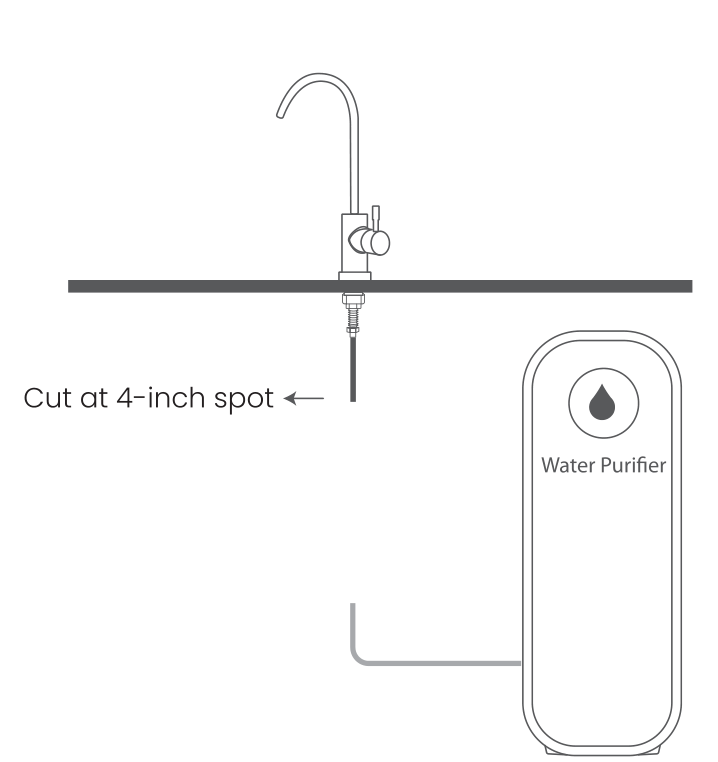
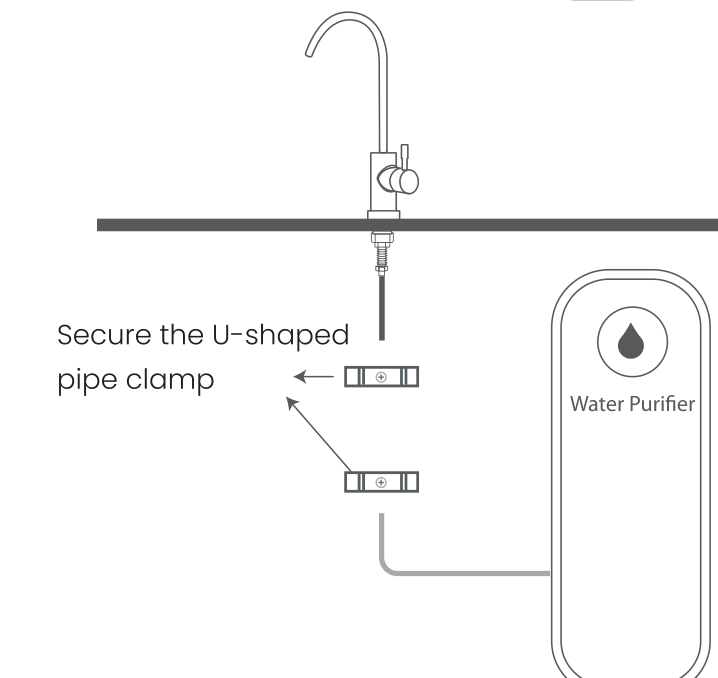
The housing carries an inlet marking. Tubes connected the wrong way round will not damage the unit, but the flow sensor will not trigger and the sterilizer will not start. Check the marking before pushing the tubing home.
What does the retrofit actually require?
Four things: a power outlet under the sink, roughly the footprint of a drinking-water cartridge, a clean cut on the permeate tubing, and pressure inside the operating range. No tank change, no additional plumbing run.
100–240 V supply
Comes with a mains adapter. The only new utility — the unit has no battery and no hard-wiring.
Under-sink space
Fitted on a U-shaped pipe clip, hung on the cabinet wall or the line itself. No shelf needed.
1/4" tubing cut
The supplied cutter is intended for the tube material only. Insert the cut end approximately 0.65 in (16.5 mm) to seat it fully.
0.1–0.3 MPa line pressure
Typical RO storage-tank pressure. Maximum 0.4 MPa (60 psi) — above that the warranty does not apply.
Tube insertion depth
Push the tube fully home into the quick-connect fitting — about 0.65 in (16.5 mm). A partly seated tube is the most common cause of a leak at a retrofit joint, so pull back gently to confirm it is locked before pressure returns.
Adapter connection
The power adapter connects to the housing with a threaded nut. Tighten it before restoring water pressure, and route the lead clear of the tubing run.
Commissioning sequence
- Close the water supply, unplug the power adapter, close the tank valve if one is fitted, then open the faucet to drain residual water and release pressure.
- Cut the tubing 100 mm (4 in) from the faucet end of the run. The cut must be clean and square.
- Decide the mounting position and fix the U-shaped pipe clip.
- Insert the cut ends into the inlet (from the purifier) and the outlet (to the faucet) respectively — check the inlet marking.
- Clip the sterilizer onto the mounting bracket and connect the power adapter, tightening the connector nut.
- Restore the water supply and open the tank valve. Open the faucet and flush for 2 minutes, then check every joint for leaks.
A blue ring means standby, green means the flow sensor has detected water and the lamp is running, red means a fault. There is no switch to remember and no schedule to follow — the unit responds to the tap.
Which model fits your system?
Match the model to the permeate flow rate of the RO system, not to the size of the tank. If the RO produces up to 1 GPM, use ZXSJ-UVC-1GPM; up to 3 GPM, use ZXSJ-UVC-3GPM. Undersizing the unit means water passes the lamp too quickly to be treated at the rated condition.
| Item | ZXSJ-UVC-1GPM | ZXSJ-UVC-3GPM |
|---|---|---|
| Rated flow rate | 1 GPM (4 LPM) | 3 GPM (11.4 LPM) |
| Water pipe fitting | 1/4" | 3/8" |
| Typical application | Domestic under-sink RO, point-of-use | Larger domestic or light commercial RO |
| CE conformity certificate | Covered | Covered |
| EPA Establishment registration | Covered | Covered |
| Status | Series flagship | Datasheet pending |
Our catalogue is sometimes written with 4 LPM and 10 LPM. Those are flow-rate descriptions, not model numbers. The model numbers on the certificate, on the packaging and on the nameplate are ZXSJ-UVC-1GPM and ZXSJ-UVC-3GPM. Use the GPM form when you specify or compare.
ZXSJ-UVC-1GPM specifications
| Model number | ZXSJ-UVC-1GPM |
|---|---|
| Product type | In-line UVC water sterilizer — post-treatment unit for RO and under-sink water purifiers |
| Rated flow rate | 1 GPM (4 LPM) |
| Working water pressure | 0.1–0.3 MPa (max 0.4 MPa) · 14.5–43.5 psi (max 60 psi) |
| Water pipe fitting | 1/4" quick-connect |
| Power adapter input | 100–240 V, 50/60 Hz |
| UVC-LED rated life | 15,000 hours (design rating — see lifespan note below) |
| Exterior material | Stainless steel |
| Operation | Flow-sensor actuated. Starts on water flow, stops when flow stops. |
| Indicator | Blue = powered / standby · Green = sterilising · Red = fault |
| Water temperature | Cold water only — 32–100 °F (0–37.8 °C) |
| In the box | Sterilizer ×1 · power adapter ×1 · 6 in (15 cm) length of 1/4" and 3/8" tube · U40 pipe clips ×2 · tube cutter ×1 |
This unit treats water that has already been purified. Do not feed it with river, lake or groundwater, or with any unfiltered supply. Unfiltered water deposits scale on the quartz sleeve, which blocks UV transmission and degrades treatment performance — and it is excluded from warranty cover.
What are the feed water limits?
Nine parameters define the operating envelope. They exist because each one affects how much UV reaches the water: hardness and iron scale the quartz sleeve, turbidity and SDI scatter or absorb UV, chlorine and pH affect the materials, and pressure affects flow. Operating outside them voids the warranty — so they are published here rather than buried in the manual.
| Parameter | Limit | Why it matters |
|---|---|---|
| Feed water pressure | ≥ 14.5 psi and ≤ 60 psi (0.1–0.4 MPa) | Below range the flow sensor may not trigger; above range the housing and joints are outside design. |
| Chlorine concentration | ≤ 1.0 mg/L (ppm) | Higher residual accelerates ageing of elastomer seals. |
| Inlet water temperature | 32–100 °F (0–37.8 °C) | Cold-water use only; output and material behaviour change with temperature. |
| Maximum hardness | < 120 ppm | Hardness is the main driver of scale on the quartz sleeve. |
| pH | 4 – 8 | Outside this band, wetted metal and seals are out of specification. |
| Turbidity | < 1.0 NTU | Turbidity shields microorganisms from UV and reduces the delivered dose. |
| Silt Density Index (SDI) | < 5 | An indicator of particulate fouling potential on wetted surfaces. |
| Maximum iron | < 0.3 ppm | Iron stains the sleeve and is difficult to remove once deposited. |
| Water use | Drinking water supply only | The unit is intended for potable water that is already microbiologically safe and clear. |
Most retrofit failures we see are not electrical or mechanical — they are water-chemistry problems that were never checked. If the feed water sits outside these limits, tell us before ordering: in some cases the right answer is upstream treatment first, not a bigger UV unit.
How long does the UVC-LED last?
The rated design life of the UVC-LED assembly is 15,000 hours. In a domestic under-sink installation the lamp is only running while the tap is open, so the rated hours are rarely the limiting factor — the quartz sleeve is. Scale and deposits on the sleeve reduce UV transmission long before the LED itself reaches end of rated life.
Rated design life
15,000 hours per the manufacturer's product specification. This is a design rating, not a validated service-life claim.
What shortens it
Drive current and thermal conditions. The unit is built for continuous flow-sensor operation at rated conditions.
The real maintenance point
Quartz sleeve cleaning or replacement, driven by water hardness and iron — which is why the feed water limits above matter.

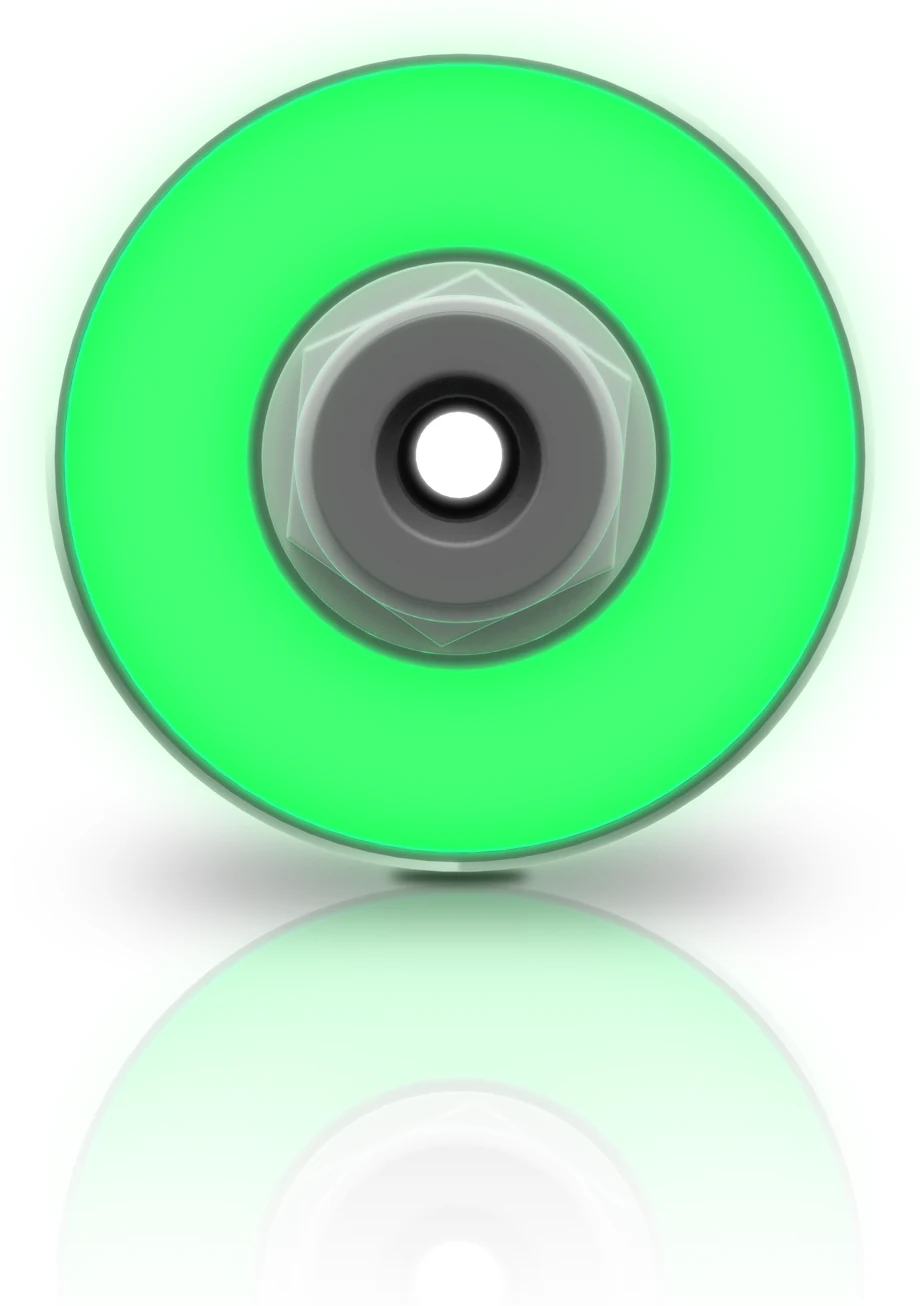
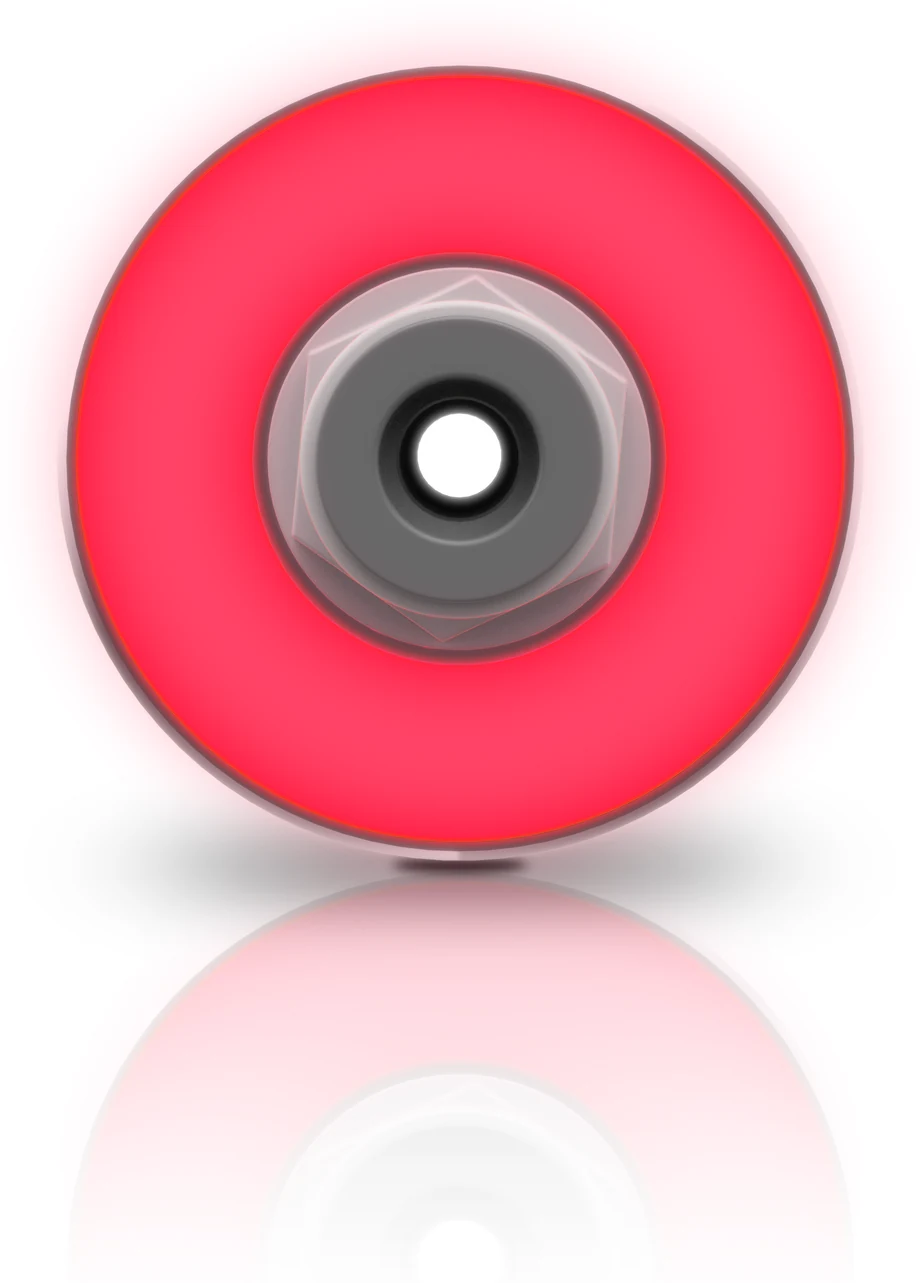
The ring light is the only routine check. There is no lamp countdown to track and no scheduled lamp swap, which is why the indicator is the first thing to look at if a complaint is ever raised downstream.
UV lamp and LED life figures are only comparable when the end-of-life criterion is the same. Some suppliers quote hours to 70% of initial output, others to 60%, and some quote a module rating rather than the emitter. Published figures from different suppliers are therefore frequently not like-for-like, and we do not claim a comparison against any other product.
Retrofit questions we get asked most
Can bacteria grow in an RO storage tank?
Yes. The membrane removes bacteria from the water passing through it, but the tank, the tubing and the post-filter sit downstream of that barrier with no disinfectant present. Published research on RO permeate held in distribution systems records biofilm accumulation on wetted surfaces and bacterial growth in the water itself, and concludes that post-disinfection needs to be part of the design. This is the specific problem the retrofit addresses.
Does my RO system remove bacteria already?
Yes — an RO membrane has a pore size of about 0.0001 micron and removes parasites, bacteria and viruses from the water it treats. Adding UV does not correct a deficiency in the membrane. It addresses what happens to that water afterwards, in the tank and the lines, where nothing is disinfecting it.
Should the UV unit go before or after the storage tank?
After the tank, before the faucet. Treating water on the way into the tank leaves the tank itself and everything downstream untreated, which defeats the purpose. The standard arrangement is also the shortest one: permeate line, storage tank, UV unit, faucet.
Will the UV unit work without a pre-filter?
No, and this is a warranty condition rather than a preference. Unfiltered water carries hardness, iron and particulates that deposit on the quartz sleeve and reduce UV transmission. CDC guidance likewise notes that UV systems that filter the water before disinfecting perform better than those that do not.
What happens if I connect the tubing the wrong way round?
The unit will not start. The flow sensor sits on the inlet side, so reversed tubing means the sterilizer never sees flow and stays in standby. Reverse the two tubes and check the inlet marking on the housing.
What voids the warranty?
Operating outside the nine feed water limits on this page, feeding the unit with unfiltered water, unauthorised modification, and use in commercial operations outside the stated operating parameters. The warranty covers parts — defects in materials, workmanship or factory preparation — for the first full calendar year from purchase, and excludes labour.
Do you supply OEM and private-label versions?
Yes. The unit is manufactured by Suzhou Purple Core Instant Purification Technology Co.,Ltd., and we work with distributors and water purifier manufacturers on OEM and ODM programmes. Send us your target market, required flow rate and branding requirements through the enquiry form and we will come back with pricing, MOQ and lead time.
Request pricing, MOQ and OEM terms
Tell us what the unit is going into. The more we know about the host system and the feed water, the more useful our first reply will be.
- Model: ZXSJ-UVC-1GPM | ZXSJ-UVC-3GPM
- Certification: CE conformity certificate · EPA Establishment No. 105777-CHN-1
- OEM / ODM: available — flow rate, fittings and branding configured to your program
- Samples: available for evaluation before volume commitment
Send an enquiry
Typical response within one business day.
This form is not yet connected to a mail service — the enquiry endpoint will be wired up at launch.
Sources and scope
4 sources
- Park, S.-K. et al. Assessment of the extent of bacterial growth in reverse osmosis system for improving drinking water quality. Journal of Environmental Science and Health, Part A, 2010. PMID 20512722. Cited for: retention of >99% of bacterial cells by the RO membrane, biofilm accumulation in RO permeate distribution systems, and the conclusion that post-disinfection must be considered.
- US Centers for Disease Control and Prevention. About Home Water Treatment Systems. Cited for: reverse osmosis pore size (about 0.0001 micron), contaminants removed by RO, and the observation that UV systems with pre-filtration perform better than those without.
- Product specifications and installation procedure: SKWEIT® UV Water Sterilizer Instruction Manual, revision 01.03 (model ZXSJ-UVC-1GPM), and the accompanying product parameter table.
- Certification status: CE conformity certificate DPCW/01068/06/KA/26 (INTERCERT Global), certificate holder Suzhou Purple Core Instant Purification Technology Co.,Ltd.; EPA Establishment registration No. 105777-CHN-1. Those documents carry a trade name that differs from the marketing brand under which the models on this page are sold, SKWEIT®. The certificate holder is Suzhou Purple Core Instant Purification Technology Co.,Ltd., the manufacturer is the same and the model numbers are identical, so the certification applies to models ZXSJ-UVC-1GPM and ZXSJ-UVC-3GPM.
Related pages
ZXSJ-UVC-1GPM in-line sterilizer
The unit used for the retrofit, its rated flow and its specified operating envelope.
Bacteria regrowth in an RO storage tank
What a removal stage leaves behind downstream, and where the barrier belongs.
PFAS and point-of-use treatment
What is enforceable today, and why a disinfection stage is not a PFAS treatment.