Feed water limits and warranty conditions
A UV post-treatment unit removes nothing, so everything it depends on is upstream of it. The published feed-water limits — turbidity, iron, hardness, pH, chlorine, temperature and pressure — are not recommendations to be traded against cost. They are the conditions under which the unit works at all, and meeting them is part of what the warranty covers. Where a supply falls outside them, the answer is to correct the treatment in front of the unit; the UV stage cannot correct it, and a unit operating outside its stated conditions is a unit whose outcome cannot be predicted from its specification.
Water has gone off after treatment?
Route the symptom before changing the hardware — water problems after treatment.
Planning the install?
Where these checks belong in the sequence — the installation guide.
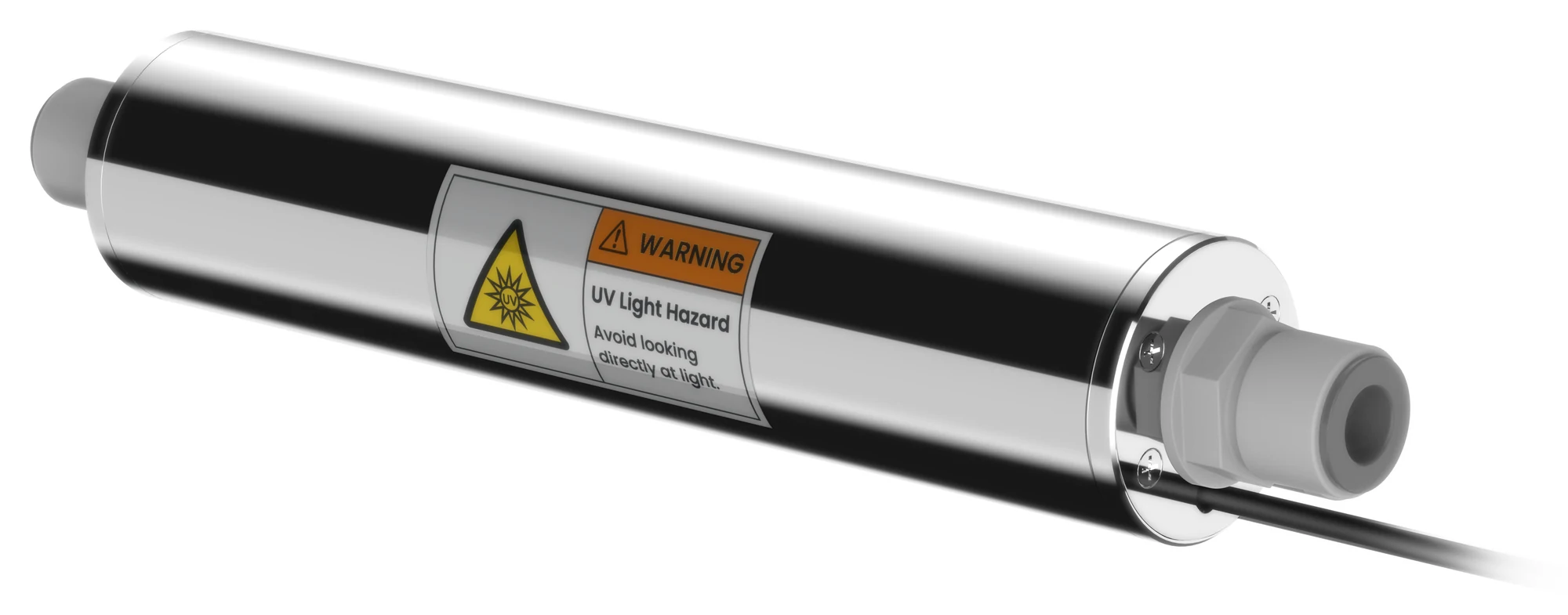
What the feed water has to be
These are the manufacturer's published feed-water limits for the ZXSJ-UVC series. They apply at the point the water enters the unit — not at the wellhead, not at the property entry, and not before the pre-filter. A supply that meets them at the source and not at the unit is a supply whose upstream treatment is not doing its job.
| Parameter | Limit | Why the unit depends on it |
|---|---|---|
| Feed water pressure | 0.1–0.3 MPa (14.5–43.5 psi) working 0.4 MPa (58 psi) maximum |
The lower bound is what the flow sensor needs in order to trigger reliably; the working band is what the housing and the joints are rated for in continuous service, with a separate maximum beyond it. |
| Chlorine concentration | ≤ 1.0 mg/L (ppm) | A materials-compatibility limit for sustained contact rather than a limit on performance. It is the reason a UV stage is placed after carbon rather than before it. |
| Inlet water temperature | 32–100 °F (0–37.8 °C) see note |
Output from a UVC-LED falls as the device runs hot, so the water passing it is part of the thermal picture. Cold-water operation only; the unit is not a hot-water device. |
| Maximum hardness | < 120 ppm | Hardness scales out on the quartz sleeve and the chamber wall. Scale absorbs ultraviolet light, so it cuts the intensity reaching the water long before the lamp is due for replacement. |
| pH | 4 – 8 | Governs the scaling and corrosion tendency of the water against the wetted parts. |
| Turbidity | < 1.0 NTU | Light has to reach the organisms. Suspended material scatters and absorbs it, and particles can carry organisms past the lamp in their shadow. |
| Silt Density Index (SDI) | < 5 | A fouling indicator for the membranes upstream. Where SDI is high, the pre-treatment is already failing and the UV stage inherits the result. |
| Maximum iron | < 0.3 ppm | Iron oxidises and deposits on the sleeve and the chamber as a coloured film. It is one of the fastest ways to lose light transmission. |
| Water use | Drinking water supply only | The unit is a point-of-use post-treatment stage for water that has already been treated, not a device for raw or process water. |
Every line in the table above is a job for a stage in front of the unit. Chlorine is a carbon job. Turbidity, iron and SDI are filtration jobs. Hardness is a softening or scale-control job. The UV stage only works when those jobs have already been done — which is why a UV complaint is almost always an upstream complaint that has finally shown up somewhere visible.
How an out-of-spec supply presents itself
| Parameter out of range | What is noticed | Which stage owns it |
|---|---|---|
| Turbidity high | No change at all until a lab result, or a taste and odour note that is blamed on the UV unit. | Sediment and carbon filtration upstream — treatment sequence for a private supply. |
| Iron above limit | Brown staining, metallic taste, and a sleeve that discolours between services. | Iron and manganese removal upstream — iron bacteria in a well. |
| Hardness above limit | Scale on the faucet and inside the cabinet; sleeve cleaning needed more often than the schedule says. | Softening or scale control upstream. |
| Chlorine above limit | Nothing observed locally; it is a durability question for the wetted materials. | Carbon upstream — placing the UV stage after carbon is the normal arrangement. |
| Temperature above limit | Nothing obvious; the consequence is on output and on service life. | A cold-water supply. The unit is not a hot-water device and there is no hot-water version in this series. |
| Pressure outside the range | Unit does not trigger when a tap is opened, or a joint begins to weep under pressure. | Pressure regulation or a booster upstream, according to which bound is being exceeded. |
What the warranty covers, and what it cannot
The conditions of use are not fine print on the warranty — they are the reason it can be offered at all. A device whose performance depends on the water it is given can only be warranted against water it was specified for. Set out plainly, the boundary runs like this.
Inside the scope
- The unit itself — housing, lamp, quartz sleeve, fittings and flow sensor — against manufacturing defect.
- Parts that fail within the stated service intervals while the feed water has been kept within the published limits.
- The specification as published: rated flow, fittings, materials and the limits on this page.
- Technical support in diagnosing a water problem, including saying plainly when the cause is not the UV stage.
Outside the scope
- Feed water outside the published limits — turbidity, iron, hardness, pH, chlorine or temperature.
- Upstream stages that were specified, sized or maintained incorrectly, including a pre-filter run past its change interval.
- A unit fitted in a position other than after the tank and immediately before the point of use.
- A unit rated below the peak draw of the line it protects.
- Water quality outcomes. The unit does not remove anything, so it cannot be warranted against a contaminant it was never able to address.
- Sleeve condition where scale or iron deposition is the cause, since both are feed-water questions rather than manufacturing ones.
Water quality is not a warrantable outcome. A UV stage inactivates micro-organisms in the water passing the lamp; it does not remove sediment, metals, hardness, nitrate or PFAS, and it cannot make water that is chemically unsafe into water that is safe. Where a supply is failing a test, the finding is about the supply and the answer is a treatment train sized to it — not a claim against a disinfection component that was never in that chain of responsibility.
Getting the numbers that decide the specification
Every limit on this page is checkable before anything is ordered, and the cost of checking is trivial next to the cost of a unit that never had a chance to work. For a private supply the useful set is short.
- Turbidity, iron, manganese and hardness. These four decide whether the UV stage has a workable feed and how often the sleeve will need cleaning. A laboratory result is the only reliable source; a strip test is a screening tool, not a specification input.
- pH and chlorine. pH governs scaling and corrosion against the wetted parts; chlorine is a materials-compatibility question at the unit's inlet, which is normally measured after carbon rather than before it.
- Pressure at the unit's proposed position. Measured with the line running, not static. A system that holds 45 psi at rest and 12 psi under draw has a pressure problem, and the flow sensor sees the second number.
- Temperature of the water as supplied. A cistern, a long external run or a supply shared with a hot-water circuit can all change this. The unit is specified for cold water only.
- Bacteriological testing where a supply is suspect, and where a well is involved, testing after a recharge event rather than only in dry weather — the result that matters is the worst one, not the average one.
Route each failing parameter to the stage that owns it — the water issues section is organised that way, with a route for each symptom. The UV stage goes in last, once the water reaching it is inside the table at the top of this page. Specifying the UV unit first and the treatment train afterwards is the sequence that produces installations which run but do not perform.
Three values that are not published here, and why
This site does not republish figures on which the manufacturer's own documents disagree. Three items fall into that category today. Naming them is more useful than quietly picking one.
| Item | Situation | What governs |
|---|---|---|
| Inlet temperature range at the upper end | The parameter table shows a cold-water range to the upper bound stated in the table above; some documents in circulation carry a slightly higher figure. Settling which is correct is the manufacturer's call, not a website's. | Treat the unit as a cold-water device. The temperature range in the manual supplied with the unit governs, and the point that matters operationally — that this is not a hot-water device — is unaffected either way. |
| Commissioning flush duration | Stated in the manual; versions in circulation express it differently. | The manual supplied with the unit you receive. See the installation guide. |
| Tubing specification for the run | Material of the connecting tubing is given differently across documents. | The manual supplied with the unit, and the tubing supplied or specified with it. |
Because a number on a compliance-adjacent page is read as settled. Where two documents disagree, publishing either one converts an internal inconsistency into an external assertion — and an installer who commissions to a web page rather than to the manual is working from the weaker source. The figures that are settled are published in full above, in the datasheets, and in the product pages.
Feed water and warranty conditions
Why does a UV sterilizer have feed-water limits at all?
Because the unit removes nothing, so its performance is set by what is in the water arriving at it. Turbidity and suspended particles reduce the light that reaches organisms, while iron, hardness and pH control how fast the quartz sleeve fouls. The limits are the conditions under which the unit behaves as its specification says it will.
Is the warranty void if the water is out of spec?
Feed water outside the published limits, an incorrectly sized or positioned unit, and neglected upstream stages all fall outside the warranty scope. The unit is warranted for the water it was specified for, and the conditions of use are how that is defined. Parts that fail within their service interval on compliant water are inside the scope.
Which limit is most often missed in practice?
Iron, and then the neglected pre-filter behind it. Iron deposits on the sleeve form a film that absorbs ultraviolet light, and the loss builds up gradually — there is no moment at which the unit stops working and announces it. The second most common is fitting a unit rated below the draw of the line, which is a specification error rather than a water quality one.
Do I need a laboratory test before specifying a unit?
For a private supply, yes — at minimum turbidity, iron, manganese, hardness and pH. These decide whether a UV stage has a workable feed and how often the sleeve will need attention. For a system drawing on a treated municipal supply where filtration is already in place, the pre-treatment is usually already doing this job, and the values can be confirmed from the system's own test records.
What if the water is fine but the unit still seems to do nothing?
Check position and flow before checking the unit. A barrier fitted before the storage tank, or a unit rated below the draw of the line, both produce an installation that runs correctly and changes nothing at the tap. The installation guide lists the failure modes that present this way.
Send us the water report
If you have a laboratory result for the supply, send it with the enquiry. It usually answers the specification question before we ask it — and where a result shows the supply falls outside the unit's conditions of use, we will say so rather than sell into it.
- Useful results: turbidity, iron, manganese, hardness, pH, chlorine, and the pressure at the proposed position under draw
- Models: ZXSJ-UVC-1GPM (1 GPM / 4 LPM) | ZXSJ-UVC-3GPM (3 GPM / 11.4 LPM)
- Feed water: drinking water supply only · cold water · within the limits published on this page
- Documentation: manual, datasheet and parameter table available on request
Send an enquiry
Typical response within one business day.
This form is not yet connected to a mail service — the enquiry endpoint will be wired up at launch. Until then, enquiries reach the manufacturer through the contact page.
Sources and scope
6 sources
- Feed-water limits (pressure, chlorine, temperature, hardness, pH, turbidity, SDI, iron and the water-use restriction): product parameter table accompanying the SKWEIT® UV Water Sterilizer instruction manual, revision 01.03, for models ZXSJ-UVC-1GPM and ZXSJ-UVC-3GPM.
- Physical basis for each limit — light scattering and absorption by suspended solids, absorbance by scale and iron deposits on the quartz surface, thermal behaviour of UVC-LED output, and scaling and corrosion behaviour against pH: attributed to general published practice for ultraviolet water treatment, not to a manufacturer test. Cited for the mechanism only; no performance figure, no inactivation rate, no log reduction and no dose value is asserted.
- Position rule — the stage belonging after any storage tank and immediately before the point of use: manufacturer's installation documentation and the behaviour of stored, unchlorinated water in contact with wetted surfaces.
- Warranty scope: conditions of use as published by the manufacturer. This page states the boundary as it is written in the manufacturer's documentation; it is not a substitute for the warranty terms supplied with a specific order.
- Three items are deliberately not restated — the upper end of the inlet temperature range, the commissioning flush duration and the tubing specification — because the manufacturer's documents in circulation differ on them. The manual supplied with the unit governs. See the table in the section above.
- Certification status: CE conformity certificate DPCW/01068/06/KA/26 (INTERCERT Global), certificate holder Suzhou Purple Core Instant Purification Technology Co.,Ltd.; EPA Establishment registration No. 105777-CHN-1, a facility registration and not a product certification. No contaminant reduction or microbiological performance certification is held or claimed.