Manufacturer: Suzhou Purple Core Instant Purification Technology Co.,Ltd. | CE: DPCW/01068/06/KA/26 | EPA Est. No. 105777-CHN-1
Guides

The documents an installer works from

Two documents cover the whole of an installation. The installation guide is the order of operations — where the unit goes on the line, how the joint is made, and what to check before it is energised. The feed-water limits are the conditions the unit depends on, which double as the conditions a warranty is assessed against. Neither is a recommendation that can be traded against cost: a unit working outside them is a unit whose outcome cannot be predicted from its specification.

Installation sequence Feed-water limits = conditions of use The manual governs, not this site
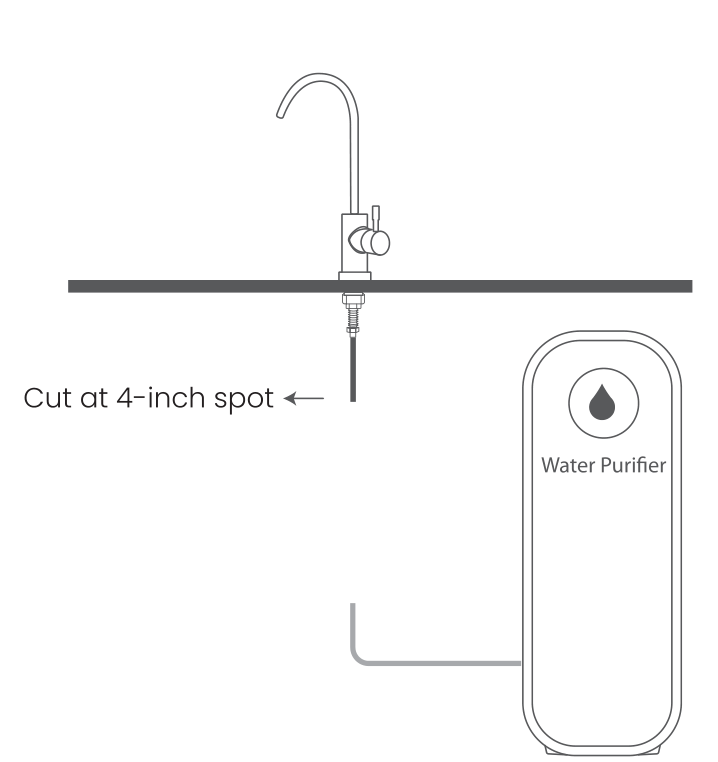
Installation figure showing where the in-line UVC unit is fitted on the treated line, after the storage tank and before the point of use
Two documents

What to do, and what has to be true first

An in-line unit is fitted into a system that already exists, which is why the guide starts with the system rather than with the box.

Procedure

Installation guide — fitting an in-line UVC unit

Isolate and depressurise, mark the cut-in point on the run after the tank, cut square, make the quick-connect joint, then check it under pressure before the unit is energised. The sequence matters more than the individual steps: the two common failures — a weeping joint and a unit that never triggers — both come from doing a later step early.

Post-tank, pre-faucet Pressure check before power
Conditions of use

Feed water limits and warranty conditions

Turbidity, iron, hardness, pH, chlorine, temperature and pressure — the published limits, what each one does to the unit when it is exceeded, and why meeting them is part of what the warranty covers rather than advice alongside it. The limits apply where the water enters the unit, not at the wellhead.

Values at the unit Not at the source
Before the unit is energised

Five checks, in this order

  1. Line isolated and depressurised. Supply closed, unit unplugged at the adapter, a faucet or the tank valve open to release system pressure before anything is cut. Working on a pressurised line is the most common cause of a joint that weeps afterwards.
  2. Cut-in point on the treated run, after the tank. Position decides what the unit can cover; a unit fitted before the storage tank leaves the standing volume in the tank and the run to the faucet unaddressed.
  3. Square, clean cut with the tubing fully seated. A quick-connect joint holds on a square cut and clean tubing. Tubing pushed in short of the stop is a joint that holds at first and weeps later.
  4. Pressure check before power. Repressurise and inspect both ports with the unit still unplugged. A leak found now costs a towel; a leak found after power-up costs a cabinet.
  5. Flow check with the outlet open. Confirm the unit actuates on flow and stops when flow stops — the indicator ring goes from standby to sterilising and back. If it does not trigger reliably, the answer is upstream pressure, not the unit.
The manual that ships with the unit governs

This page describes the sequence in general terms. The binding procedure is the instruction manual supplied with the unit you receive — where the two differ, the manual is the document that applies. A copy can be issued ahead of an order on request.

Deliberate gaps

Three things these guides will not tell you

A dose figure to work to

No UV dose in mJ/cm² is published, because a dose describes a product together with the conditions it was measured under. Sizing here is by the flow the unit is rated for at the position it is fitted.

A replacement interval in months

The lamp has a design rating and the sleeve fouls with water quality, so a calendar interval would be a guess presented as a schedule. What to base the interval on is set out in replacement and service.

A performance figure for the installation

The unit is one stage of a train. What the train achieves depends on the stages in front of it, so a number for this unit alone would describe a system that does not exist.

A question the guide does not settle

Send the line you are working on, the water test result if you have one, and where the unit will sit. Most installation questions are answered by those three.

  • Models: ZXSJ-UVC-1GPM (1 GPM / 4 LPM, 1/4") | ZXSJ-UVC-3GPM (3 GPM / 11.4 LPM, 3/8")
  • Available now: instruction manual · parameter table · CE certificate DPCW/01068/06/KA/26 · EPA Establishment No. 105777-CHN-1
  • Issued per order: net weight, unit dimensions, carton data, pricing, lead time

Send an enquiry

Typical response within one business day.

This form is not yet connected to a mail service — the enquiry endpoint will be wired up at launch. Until then, write to sales@skweit.cn or through the contact page.

Scope and document control

4 sources
  1. The sequence on this page is a general description of an installation. The binding procedure is the instruction manual supplied with the unit, and the binding limits are the manufacturer's published feed-water figures.
  2. Nothing on this page is a performance claim. No microbiological inactivation rate, no log-reduction figure, no UV dose value and no validated service life is stated or implied for either model.
  3. Installations must comply with national and local plumbing and electrical regulations. An in-line unit is a post-treatment component and requires pre-filtered drinking water as feed water.
  4. Where a market requires an evidenced lifetime claim for the UVC-LED assembly, the qualification runs under that market's own programme; the 15,000-hour figure is a design rating and is not presented as evidence.

Document control. Published 10 October 2026 | Reviewed by the SKWEIT® technical documentation team. Author: SKWEIT® technical documentation (Suzhou Purple Core Instant Purification Technology Co.,Ltd.).

Scope note. Written for a technical reader: installers, dealers and OEM engineers. Not a warranty in itself — warranty conditions are as stated on the feed-water page and in the documents supplied with the unit.