Biofilm in a water storage tank
Flushing a tank flushes the water. A biofilm is not in the water — it is on the surface. Attached growth is a community of micro-organisms held against a wall, a bladder, a gasket or a length of tubing by a matrix the cells produce themselves. Water passing over that surface carries away only what has already detached. The layer itself stays where it is, which is why a tank can be rinsed on a schedule for years and still taste different after the water has stood in it.
The tank feels slippery, or smells after standing
That is the surface, not the water — see how a biofilm establishes itself.
I have fitted a UV unit and the growth is still there
A UV stage acts on the water as it flows past the lamp, and it does not act on a surface — the order that addresses both.
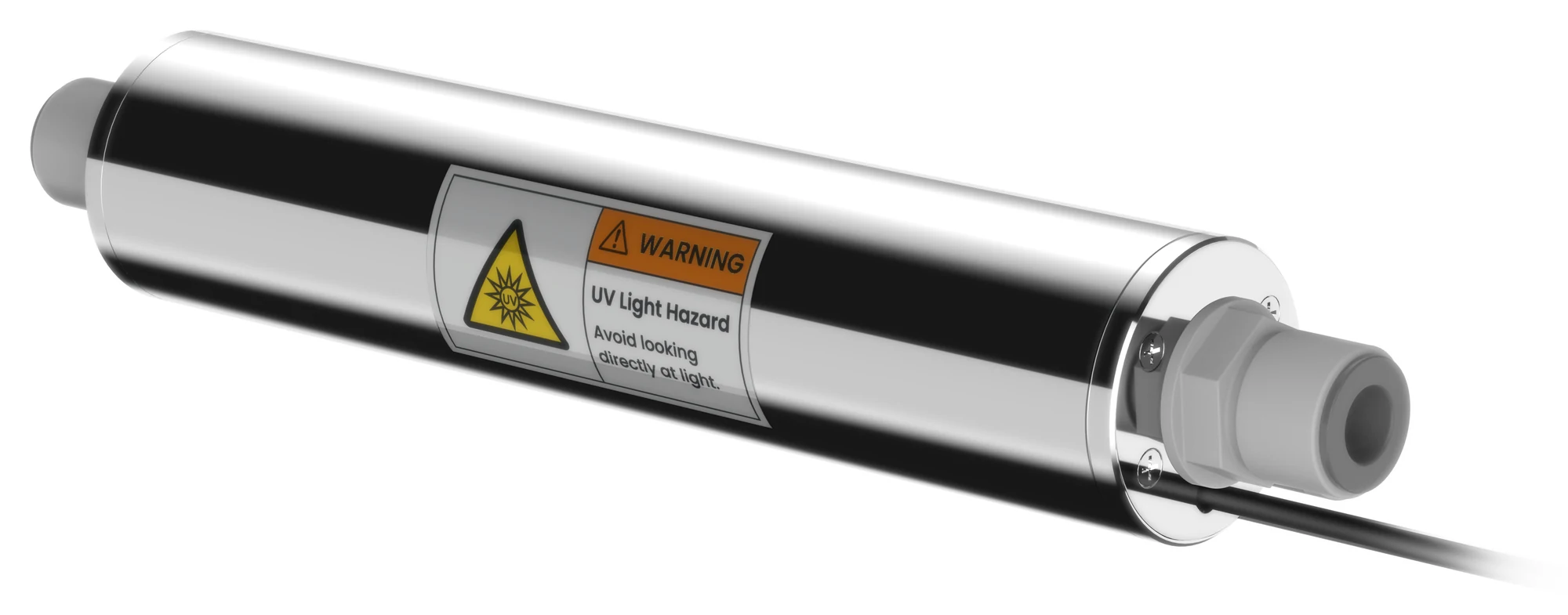
UV is a disinfection component. It has no media and no membrane, so it is not a removal stage — and it is not a stand-alone purifier. Everything dissolved is decided upstream of it.
Micro-organisms in a system live in two places, and only one of them is the water
In a treated water system there are two populations, and they behave differently. Some micro-organisms are suspended — free-floating in the water, carried wherever the water goes. The rest are attached — settled onto wetted surfaces and held there. A storage tank offers a great deal of wetted surface and long periods of still water, so the attached population is usually the larger and the more persistent of the two.
The distinction matters because every ordinary remedy — drawing water, flushing the tank, dosing the system — acts first on the water. Only one of the two populations is in the water.
| Suspended (planktonic) | Attached (biofilm) | |
|---|---|---|
| Where it is | In the water itself, moving with the flow. | On the surface — tank wall, bladder, gaskets, the first metres of tubing after the tank. |
| What flushing does | Removes it. Water leaving the tank carries suspended cells with it. | Removes the outermost layer only. The bulk of the growth is bound to the surface and stays. |
| What a chemical dose does | Acts directly, because the water is what carries it. | Slower and less complete. The matrix the cells produce limits how fast a disinfectant reaches them. |
| What a water sample shows | The count present at the moment of sampling. | Only what has detached. A sample is not a measurement of what is on the surface. |
| How it is removed | Flushing, replacement of stored water, water-phase treatment. | Physically — cleaning the surface, or replacing the part. No water-phase step removes it. |
Attached growth sheds cells into the water continuously but unevenly, so a single negative sample can be taken between sheds. Read the other way round, the evidence is stronger: a positive sample points almost always to a population established somewhere upstream of the tap. If the result keeps changing between visits, that variability is itself more consistent with a surface source than with a permanent problem in the water.
How a biofilm establishes itself on a surface
Attachment happens in stages, and the stages are what explain why the same remedy works in one week and not in the next.
- A conditioning layer forms first. Before any organism settles, dissolved organic material in the water adsorbs onto the surface and changes it. This takes minutes rather than days, and it happens on any wetted material.
- Cells attach reversibly. Micro-organisms arrive and associate with the surface weakly. At this stage a flow of water can still carry them away — which is why early flushing appears to work.
- Attachment becomes irreversible. The cells anchor themselves and begin to produce an extracellular matrix that binds them to the surface and to each other. This is the transition that matters: after it, the growth is no longer something water passing by will remove.
- The community matures and sheds. As the layer thickens it develops its own internal structure, and cells detach from the outer layer into the water. That shedding is the source of the intermittent positives, the occasional taste, and the reason the problem seems to come and go.
Steps one and two are reversible. Step three is not. It is also invisible: nothing about the appearance of the tank changes at the point where rinsing stops working. That is why a maintenance routine that was effective when the system was new can quietly become ineffective without anyone changing anything.
A disinfection stage is not a filter, and the difference matters at the point of sale: nothing is removed from the water, and no protection follows the water out of the chamber.
Why water-phase measures reach the water and not the surface
The matrix is a barrier
The material the cells produce around themselves slows the movement of a disinfectant inward and of reaction products outward. What reaches the deep layer of a mature biofilm is a fraction of what was dosed into the water.
Water does not flow everywhere
Growth concentrates where flow is slowest or absent: behind a bladder, around a gasket, in the seam of a fitting, along a length of tubing that only sees water when the tap is used. These are the places a flush is least able to reach.
Removal is not the same as prevention
Even where attached growth is properly removed, the conditions that produced it are unchanged. Without a continuous step in place afterwards, the surface is re-colonised from whatever reaches it next.
Removing established growth is a one-off physical task — cleaning a surface, or replacing the part that carries it. Keeping water free of what re-enters afterwards is a continuous task, and it happens in the water. A system needs both, in that order. Treating one as the other is where most of the confusion comes from.
The order that addresses the surface and the water
Each of the first three steps is what makes the fourth meaningful. A barrier installed ahead of the growth is treating water that is about to be re-contaminated by the surface it flows past.
- Establish that it is a surface problem. Look for the physical signs — slipperiness on the tank wall or bladder, a film on a gasket or on the inside of the outlet tubing. Where growth is visible or can be wiped from a surface, the question is already answered, and no amount of work on the water will settle it.
- Remove the growth physically. Cleaning the wetted parts, or replacing the tank, the bladder, the gaskets or the affected length of tubing, is the only step that removes attached growth. A water-phase disinfection alongside it does not substitute for it.
- Shorten the wetted run after the tank. Every metre of tubing between the tank and the point of use is a surface with no disinfectant residual on it, and a place for water to stand between draws. Reducing that run costs nothing.
- Place a continuous barrier last, after the tank. An in-line ultraviolet stage installed on the line between the storage tank and the faucet acts on the water as it moves to the point of use — after the surfaces that shed into it, not before them.
- Keep it working: flow and maintenance. Regular draws rather than long standing periods, periodic cleaning of tank and quartz sleeve to the manufacturer's instructions, and replacement of the lamp at the end of its rated life.
A UV stage is a barrier in the water, not a cleaning step on a surface. It belongs downstream of the surfaces that shed into the water and upstream of the point of use. Installed anywhere else, it is a correctly working component in an arrangement that cannot produce the result it was bought for.
Where the stage sits relative to the tank
| Position | What it can act on |
|---|---|
| On the feed line, before the tank | Raw or pre-treated feed water. Everything the tank and the outlet line add afterwards arrives after the barrier, so it does not address the surface problem at all. |
| Between the membrane and the tank | Water on its way in. That water then stands in the tank, in contact with the surfaces that shed into it. The barrier is upstream of the growth. |
| After the tank, before the faucet | The position the unit is specified for. The stage acts on the water after the surfaces that seed it and before it is drawn, on the line that reaches the point of use. |
| Where there is no room on the outlet line | Worth solving rather than working around. Moving the stage to a convenient line upstream returns it to a position where it cannot act on what the tank contributes. |
The unit is specified for feed water that has already been filtered and is clear, within stated limits for turbidity, iron, hardness, pH, chlorine, pressure and temperature. Those limits describe when the lamp can do its job. They are not a statement about what the water will contain afterwards, and they are not a claim about any installation.
Three ways the response misses the target
- Rinsing is repeated, on a schedule, for years. Flushing lowers the number of suspended cells for a while, the water seems to improve, and the growth on the surface is untouched. The interval between cleanings shortens and the routine is read as normal wear rather than as a remedy that was never addressing the cause.
- The water is treated and the surface is left. A dose, a flush or a new filter cartridge changes the water. Growth behind a bladder or inside outlet tubing is still there, and it resumes shedding into the water as soon as the system is back in service.
- A UV unit is installed without cleaning first. The barrier works exactly as specified on the water that reaches it, while the tank continues to supply the water with whatever detaches from its surfaces. The result is a system that is partly right, which is harder to diagnose than one that is plainly wrong.
Look at the surface before deciding what to do about the water. Remove what is attached — clean it or replace the part. Shorten the run after the tank. Then place a continuous barrier last, immediately before the point of use, and keep it maintained. Surface first, water second, in that sequence.
Biofilm in a water storage tank
What exactly is a biofilm?
A community of micro-organisms attached to a surface and held there by a matrix the cells themselves produce. It forms on any wetted surface in contact with water that has no disinfectant residual — tank walls, bladders, gaskets, fittings and the inside of tubing. It is not a layer of dirt carried by the water; it is growth that belongs to the surface.
Can I remove it just by flushing the tank?
Flushing removes suspended cells and the loosest outermost material. Once cells have anchored themselves and begun producing the matrix, the growth is bound to the surface and a flow of water over it will not take it away. Repeated flushing can reduce what a sample detects in the short term without changing what is growing in the tank.
Will shock chlorination remove a biofilm?
It acts more strongly on micro-organisms suspended in the water than on established attached growth. The matrix around a mature biofilm limits how quickly a disinfectant reaches the cells inside it. A dose is a reasonable part of a cleaning procedure; it is not a substitute for physically removing the growth or replacing the parts that carry it.
Does UV remove biofilm from a tank surface?
No. An in-line UV stage acts on micro-organisms in the water as it passes the lamp. It does not act on a surface, and it does not remove growth that is already attached. Established biofilm has to be removed physically or the part replaced; the role of the UV stage is to act on what reaches the water afterwards, on its way to the point of use.
How do I tell whether my tank has a biofilm?
A negative water sample does not rule it out. More useful evidence is physical — a slippery feel or a visible film on the tank wall, the bladder, a gasket or the inside of the outlet tubing — and comparative: sampling at the tank inlet and at the faucet shows whether growth is happening after the tank. A maintenance record in which symptoms return soon after every cleaning points the same way.
Describe the tank, not the symptom alone
Tank type and size, what the internal surfaces are made of, the length of the run to the faucet and how often it is drawn from are what make a useful reply possible — the placement question answers itself once the layout is known.
- Models: ZXSJ-UVC-1GPM | ZXSJ-UVC-3GPM
- Credential: CE conformity certificate DPCW/01068/06/KA/26 · EPA Establishment No. 105777-CHN-1 (facility registration)
- Scope: in-line UVC post-treatment for water that has already been filtered
- Samples: available for evaluation before a volume commitment
Send an enquiry
Typical response within one business day.
This form is not yet connected to a mail service — the enquiry endpoint will be wired up at launch.
Sources and scope
5 sources
- Definition and structure of a biofilm — attached microbial community plus a self-produced extracellular matrix: attributed to general microbiology. Cited for: the statement that attached growth belongs to the surface rather than to the water passing over it.
- Stages of biofilm formation, from conditioning layer through reversible attachment and irreversible anchoring to maturation and detachment: attributed to general microbiology. Cited for: why early flushing appears effective and later flushing does not.
- Limited penetration of disinfectants into a mature biofilm matrix: attributed to general microbiology. Cited for: the statement that a water-phase dose acts more strongly on suspended micro-organisms than on established attached growth.
- Installation position, feed-water pressure range and feed-water limits quoted on this page: the manufacturer's product documentation and installation manual, revision 01.03.
- Lamp life: manufacturer design rating of 15,000 hours at not less than 60 per cent of initial output, per the supplier reliability documentation. Cited here as a design rating — not a validated service-life claim. Actual life depends on drive current, thermal conditions and water quality.