Recontamination after treatment: the four points where clean water meets something again
Water that leaves a treatment stage clean does not stay clean on its own. Between the last stage and the tap there are four physical places where water meets air, a surface or time — the storage tank, the wetted fittings and tubing, the faucet and its aerator, and a line that is not being drawn from. None of the four is a treatment fault, and none of them is fixed by adding another stage. This article lists what each entry point actually is, what each one needs in response, and where a point-of-use ultraviolet stage sits in relation to them.
Why the last metre behaves differently from the treatment train
Every stage of a treatment train works the same way: water passes through it once, and while it is inside that stage something happens to it. A sediment filter holds particles back. A carbon block adsorbs what it is designed to adsorb. A membrane rejects dissolved material. An ultraviolet chamber treats the water in the moment it is between the lamp and the chamber wall. Each of these is a pass-through event, and it is finished when the water leaves.
What stands after the last stage is not a pass-through. It is a stretch of line where water is held — in a vessel, in tubing, behind a fitting, in the body of a faucet — and holding changes the two variables that a treatment stage never has to deal with. The first is time: water that sits is water that is no longer moving. The second is surface: water in a line is in contact with the materials of that line, and material surfaces are where micro-organisms attach in the first place.
This is why recontamination is not a sign that a treatment stage has stopped working. It is a property of the part of the system that was never treating anything — and it is the reason a point-of-use stage belongs at the end of the line rather than in the middle of it.
The storage tank or pressure vessel
A reverse osmosis system that stores permeate in a bladder tank creates the first entry point by design: a volume of treated water is deliberately held so that it is available instantly. Two things happen inside that volume. Water is in contact with the bladder and the interior wall for as long as it is stored, and the tank has a headspace — a pocket that is not full of water, and where the water surface meets whatever the pressurised gas or air side contains.
Permeate is also not the same water as the feed. A membrane removes most of the dissolved content, which is why permeate is by nature low in the minerals and the residual disinfectant that a municipal supply carries. Water that is low in dissolved content and completely still is a different environment from moving mains water, and the tank is where it spends the longest period of its journey in that state.
What the tank needs in response is turnover and materials, not another treatment stage: drawing from the tank regularly so that stored water is replaced, and using a vessel whose wetted materials are intended for potable water service. A point-of-use stage fitted after the tank does not address this entry point — it addresses what arrives at the fixture afterwards, which is why its position is on the permeate line and not inside or before the vessel.
Where a problem has already been observed at the tank rather than reasoned about, the two station pages that take the symptom itself are regrowth in an RO storage tank and biofilm in a water storage tank. This article is about where the four entry points are; those pages are about what a symptom at each of them looks like.
Fittings, tubing and the wetted path
Between the tank and the fixture there is tubing, and at every change of direction or connection there is a fitting. Each fitting is a place where water meets a surface that is not the smooth bore of a pipe: a collet, an O-ring, an insert, a threaded joint, a length of tubing that passes through a cabinet and warms and cools with the room. These are ordinary plumbing and none of them is a defect.
The distinguishing feature of this entry point is not the fitting itself but what the layout around it does with water. A dead leg — a short branch that leads to a fixture that is rarely used, or a spur left behind when a system was reconfigured — holds a static volume that the main flow never sweeps. A long run of narrow tubing to reach a distant tap holds a larger volume than is needed, and that volume changes over more slowly than the volume in a short run. Both are layout questions, and both are answered by layout: keep runs short, keep branches either in use or removed, and avoid volumes that the system never exchanges.
There is a second, quieter aspect to this entry point. A joint that weeps slightly, or tubing that draws a small amount of air, introduces both water on the outside of the line and air on the inside of it. Neither shows up as a leak large enough to notice, and both change what the line is.
The faucet and the aerator
The faucet is the one entry point that sits downstream of everything else, including any point-of-use stage fitted to the line. Two features make it different in kind from the tank and the tubing.
The first is the aerator, where the stream is mixed with room air to soften the flow. The device that does this is a screen with a large internal surface area, it holds a film of water after every use, and it is exposed to room air between draws. It is the most intimate mixing of water and outside air anywhere in the system, and it is fitted at the last possible moment before the water is poured.
The second is simply position. The spout is the end of the line, so the water that leaves it has experienced every feature described in this article in sequence: it was held in the tank, it travelled the fittings, and now it is passing an aerator that has been sitting in room air. A point-of-use stage placed on the line protects the water up to the fixture; it cannot protect the fixture's own internal surfaces, because those are past its outlet.
The practical response is routine rather than technical, and it is the same response in a domestic kitchen, a laboratory sink and a commercial back-of-house: clean and, where the design allows, replace the aerator on a schedule, and do not treat the faucet as though it were part of the treatment train.
A line that is not being drawn from
The fourth entry point is not a component. It is the absence of use, and it behaves differently from the other three because it is the only one wholly governed by time.
Consider two taps fed from the same treated line. One is drawn from several times a day: its contents are exchanged continuously and the water standing in it at any moment is minutes old. The other is a tap in a guest room, a spare laboratory sink, a drinks station that runs in season — drawn from once a week, or once a month. Both taps are correct installations, and the second is a different water environment from the first, because the water in it is not minutes old but days or weeks old.
This is the entry point that most often gets diagnosed as something else. A sample taken from a rarely used tap can differ from a sample taken from a busy one on the same line, and the difference is not the line — it is the time. The same logic applies to the first draw of the morning from any tap: the volume that has been standing overnight is not the same as the volume that follows it.
The response is a usage habit, not a component: flush a line that has been idle before taking water from it, bring infrequently used fixtures into a routine, and where a branch genuinely has no use, consider whether the system should feed it at all.
Where a point-of-use stage sits in relation to the four
The four entry points are the reason the end of the line is the useful place for a point-of-use ultraviolet stage. Positioned after the tank and after the fittings, and as close to the fixture as the run allows, it is the last thing the water passes before it is drawn. Everything that can be addressed on the line has been addressed by the time the water reaches it.
Three boundaries follow from the same reasoning and are worth stating plainly, because each is a common source of a mismatched expectation.
- It does not reach upstream. A stage on the permeate line treats the water passing through it. It does not treat the contents of the tank, and it does not make the tank a treated vessel.
- It does not reach downstream. Ultraviolet leaves no residual in the water, so nothing carries past the chamber. The aerator and the spout are downstream of every treatment stage, including this one.
- It acts on what is alive, not on what is dissolved. A disinfection stage is the wrong instrument for dissolved material, which is decided upstream by the removal stages.
Read together, the four entry points and the three boundaries describe a single idea: on a point-of-use line, treatment and recontamination are two different subjects, handled by two different kinds of measure. The first is a stage. The second is turnover, materials, layout, and a habit of use.
Two further pieces connect to this one by subject rather than by conclusion. Why ultraviolet leaves no residual is the boundary stated as a property of the technology; what UV transmittance decides is the water-side condition that governs whether the stage placed here is sized for the water it will actually meet. For placement on a specific system, the two station pages are under-sink UV and retrofitting UV onto an RO line.
Recontamination and point-of-use placement
Does a point-of-use UV stage stop recontamination?
It treats the water that passes through it, and it sits as late on the line as the installation allows, so it is the last stage the water meets before the fixture. It does not remove the four entry points, and it cannot reach the faucet's own internal surfaces, which are past its outlet. The accurate expectation is that it addresses the water arriving at the fixture, not that it makes the rest of the line sterile.
If the storage tank is the problem, should the UV unit go before it instead?
Those are two different objectives and they are chosen deliberately, not by accident. A stage placed before the vessel acts on the water entering it; a stage placed after the vessel acts on the water that will actually be drawn. Because the water drawn is the water that has spent time in the vessel, the after-tank position is the one that addresses the water at the point of use. Whichever is chosen, the fixture and the aerator remain downstream of both.
How do I tell which of the four entry points is my problem?
Work backwards from where the water is used, because that is where the four converge. The fixture and its aerator are the only entry point that is downstream of everything, so they are the first thing to inspect and clean. Then look at layout — how long the run is, whether any branch is unused — and then at use, because a rarely drawn tap is a different environment from a busy one. Sampling can confirm a difference between two points on the same system, but a difference between two taps is not by itself evidence that the treatment has failed.
Is recontamination a sign that a treatment stage has failed?
Not on its own. Every treatment stage is a pass-through event that is complete when the water leaves it, and the changes that follow happen in the part of the system that was never treating anything. A treatment stage and the holding line after it are separate subjects; treating the second as evidence about the first is the most common misreading of a result taken from a rarely used tap.
Does a rarely used tap need its own solution?
Often the solution is use rather than equipment: flushing the line before drawing water after an idle period, and bringing the fixture into a routine. Where a branch genuinely has no use, the decision is whether the system should feed it at all — an unused branch is a larger question than an unused tap. Adding a further treatment stage to an unused line does not address the reason the line differs from the others.
Sketch the line for us
Which of the four entry points matters depends entirely on the system, so the useful starting point is a description of yours: where the storage vessel sits, how long the run to the tap is, and which branches are drawn from and which are not. Send that and the question becomes answerable.
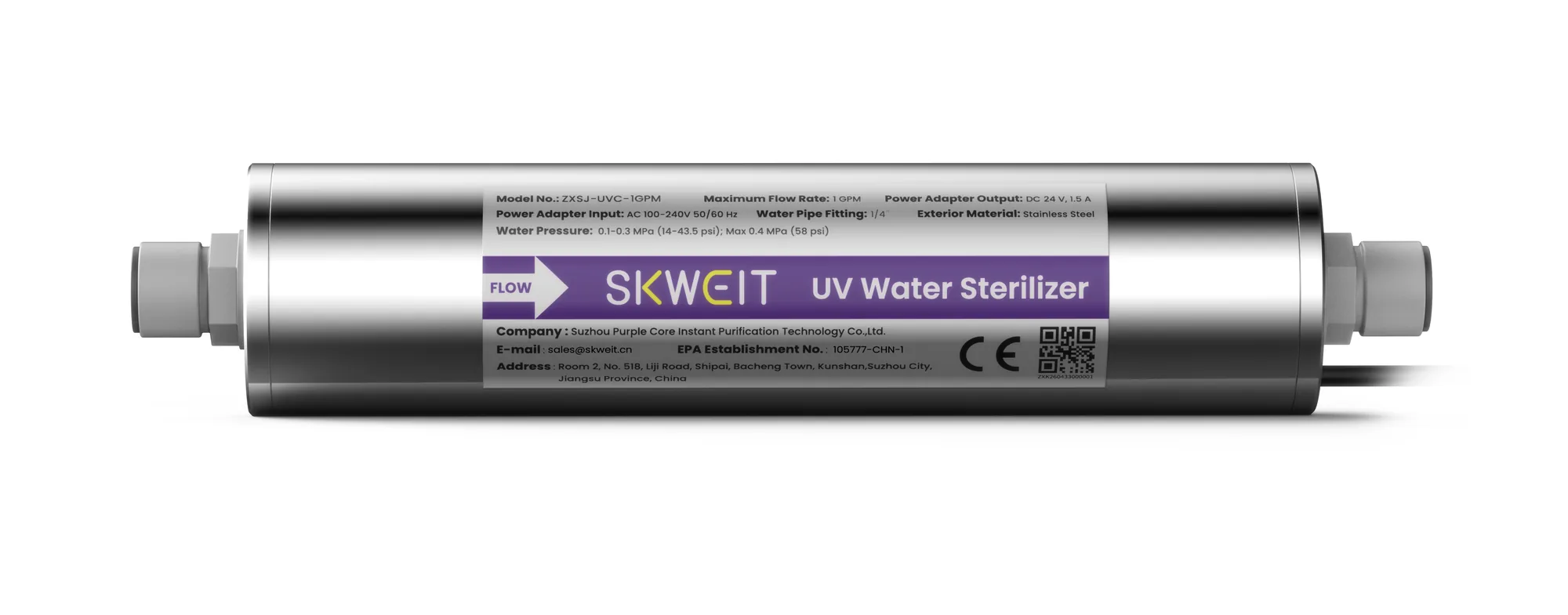
- Models: ZXSJ-UVC-1GPM (1 GPM / 4 LPM, 1/4") | ZXSJ-UVC-3GPM (3 GPM / 11.4 LPM, 3/8")
- Available now: instruction manual · parameter table · CE certificate DPCW/01068/06/KA/26 · EPA Establishment No. 105777-CHN-1
- Not held: a microbiological report, a sampling protocol and any validated service life — this article sets out why the entry points are addressed by layout and habit rather than by a figure
Send an enquiry
Typical response within one business day.
This form is not yet connected to a mail service — the enquiry endpoint will be wired up when it is connected. Until then, enquiries reach the manufacturer through the contact page.
Sources and scope
4 sources
- The description of a treatment train as a sequence of pass-through stages, and of the point-of-use line after it as a held volume rather than a passing one, follows general practice in point-of-use water treatment. No figure from any published source is reproduced here as a specification for our product.
- Product and placement statements: the manufacturer's own product documentation for the ZXSJ-UVC series, including the instruction manual shipped with the unit. Placement is stated as a principle of system design, not as an installation instruction for a particular system.
- Deliberately not published: any inactivation rate, log-reduction figure, dose value, cleaning or replacement interval figure, and any validated service life. Where a figure would have to come from a test the manufacturer has not run on a specified water, no figure appears here.
- Where a symptom has already been observed at one of the entry points rather than reasoned about, the pages that take the symptom itself are the two station pages on regrowth in an RO storage tank and on biofilm in a water storage tank, both linked in the text above.