mJ/cm² and µW/cm² are not two ways of writing the same thing
They measure two different quantities. mJ/cm² is a dose — energy delivered per unit area — and answers “how much did the water receive in total”. µW/cm² is an irradiance — power delivered per unit area — and answers “how strong is the light at this moment”. One is a quantity and the other is a rate, and the only bridge between them is time: a dose is an irradiance multiplied by how long it was applied. So a figure in µW/cm² cannot be turned into one in mJ/cm² until the exposure time is known — and a specification that offers the other one is not giving a shorter answer, it is giving a different quantity.
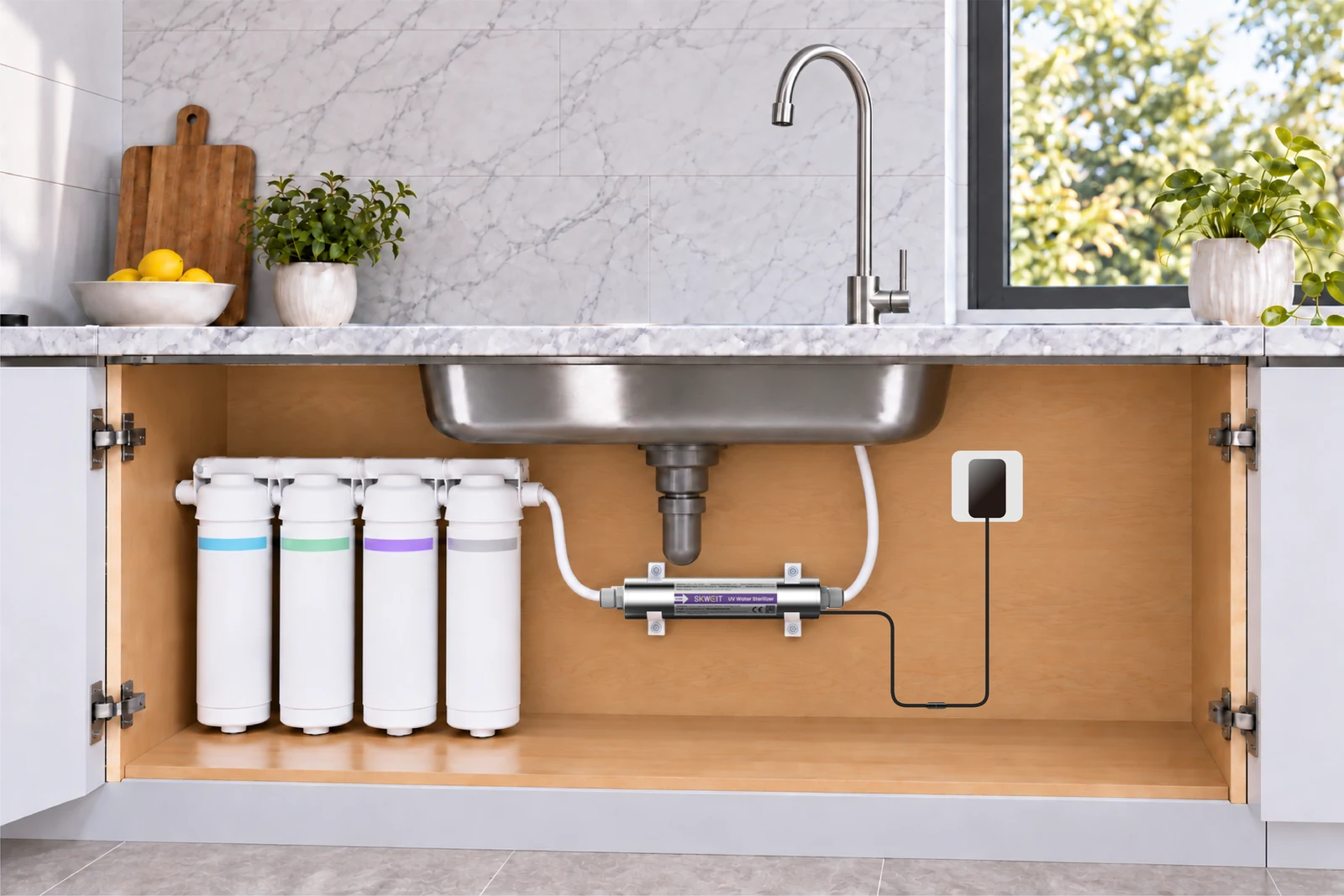
A quantity and a rate — two different questions
A dose answers how much. An irradiance answers how strong. They are related the way a distance is related to a speed: both describe the same journey, one as a total and one as an instant, and neither can be derived from the other without knowing how long it lasted. A statement that a vehicle travelled 30 km says nothing about its speed; a statement that it was moving at 60 km/h says nothing about the distance it covered. You need the third number — time — before either converts into the other.
Ultraviolet specifications have exactly the same structure, and the same missing third number. An irradiance figure describes the light field at a point. A dose figure describes what water passing through that field accumulated. A chamber's job is to turn the first into the second, and it does that by deciding how long the water is in the field, which is the sizing problem in its other form.
The confusion this article is about is not a matter of notation. It is that a number with the right shape — digits, a slash, cm² — is often read as if it answered whichever of the two questions the reader had in mind. When a supplier quotes µW/cm² and a buyer expected a dose, both are looking at a legitimate number, and they are looking at different quantities.
Taking the two units apart
Both units are built from the same three pieces, and which pieces are used is what distinguishes them. Energy is measured in joules (J). Power is energy per unit time, measured in watts (W) — one watt is one joule per second. The area is in cm² in both cases.
Two consequences follow straight from the pieces. The first is that an irradiance figure has a time hidden inside its definition — it is a rate — and the second is that a dose figure does not. A dose is already an accumulation; the time has been used up producing it.
The bridge between them is time
The relationship is a multiplication:
dose (mJ/cm²) = irradiance (mW/cm²) × time (s)
Note what that requires: the irradiance has to be in milliwatts per cm² for the result to come out in millijoules, because a milliwatt applied for one second delivers one millijoule. If the irradiance is quoted in microwatts, the same equation still works, and the result arrives in microjoules — which is then divided by a thousand to give millijoules.
Two rules of thumb make the arithmetic safe to do in your head. One mJ/cm² is one thousand microjoules per cm², and one milliwatt per cm² is one thousand microwatts per cm². Hold both, and any conversion within these units is a matter of moving a decimal point and multiplying by seconds — no table required.
What does not exist is a fixed conversion factor between the two units themselves. It is a common and understandable expectation — that µW/cm² and mJ/cm² are like metres and feet, and a single number would convert one into the other. They are not, and no such number exists, because the conversion depends on a quantity neither unit contains. This is the same structural point that makes a dose figure meaningless without its test conditions: the number is the end of a calculation, and the calculation has inputs.
A worked example, and where it stops being true
Suppose a water sample sits for 5 seconds in a field whose irradiance is 2 mW/cm² — which is 2,000 µW/cm². Applying the equation:
That multiplication is exact — and it is exact only under an assumption that a real chamber does not meet. It assumes the irradiance is uniform: the same value everywhere in the volume the water occupies, and the same for every parcel of water passing through. Neither holds. Light falls away with distance from the source, and it is attenuated by the water itself, so irradiance varies across the chamber and along the path. Water near the source and water at the far wall do not receive the same light, and neither do parcels moving at different positions across the section.
So the arithmetic above tells you how the two units relate, which is what it is for. It does not tell you what dose a real unit delivers, and it cannot be used to invent one: turning a nominal irradiance into a delivered dose requires the geometry of the chamber, the water's transmittance at the treatment wavelength, the flow and its profile, and the condition of the source — and then a validation, which is exactly why a dose figure is quoted with the conditions it was established under or not quoted at all.
The prefix is part of the number
Most mistakes with these units are not conceptual. They are the prefix, dropped or misread — and the prefixes in this family are separated by factors of a thousand, which means a slip does not produce a slightly wrong figure. It produces one that is wrong by orders of magnitude.
mJ against J. One joule is one thousand millijoules. A dose written as “50” without its prefix could be 50 mJ/cm² or 50 J/cm², and those are not neighbouring values.
µW against mW. One milliwatt is one thousand microwatts. Irradiance figures for these systems are commonly given in either, and the difference between a reading of 2 and a reading of 2,000 is entirely the prefix.
cm² against m². One square metre is ten thousand square centimetres. The convention in this field is the square centimetre, and a figure converted to per-square-metre without saying so is off by four orders of magnitude.
The practical rule is short: a UV figure without its prefix, its area basis and its quantity does not carry a value. It carries a shape. Where a specification, a label or a sales message offers digits and a slash without all three, the useful response is to ask for the missing part rather than to assume the conventional one — because the conventional one is exactly what a mistranscription gets wrong.
Neither unit carries its wavelength
Both units are silent about wavelength, and the quantity being measured is not. Ultraviolet treatment works over a band, and the germicidal effectiveness of a given amount of energy depends on where in that band it sits — different wavelengths are not equally effective per unit of energy. A dose figure and an irradiance figure therefore describe light at a wavelength, and the wavelength has to travel with the number for the number to mean anything.
The reason it is easy to forget is that the unit looks complete. “mJ/cm²” has all the pieces its own arithmetic needs, and the arithmetic is exact — it is just arithmetic about energy, not about effect. Two figures in the same unit, obtained at different wavelengths, are comparable as energy and not necessarily comparable as treatment. This is the same requirement that makes a transmittance figure carry its wavelength, and the underlying reason is worth stating plainly: the number belongs to a measurement, and a measurement has conditions.
The corollary matters when comparing sources, and it is a live difference between lamp types. A low-pressure mercury lamp emits in a narrow band around 254 nm; an ultraviolet LED emits over a band centred on a wavelength chosen by the manufacturer. The comparison of the two technologies is a subject of its own. For this article the relevant point is narrower: a figure quoted for one says nothing directly about the other, because the digits are in the same unit and the light is not the same light.
A six-point check for a UV figure in a document
Any figure carrying one of these units can be made checkable by six questions, and all six are answerable from the document itself. They are worth running in order, because the first two disqualify a figure that cannot be read at all.
One — is it a dose or an irradiance? Establish which quantity before looking at the digits. A figure offered in place of the other is not a shorter answer; it is a different quantity, and the gap has to be closed before anything else is assessed.
Two — is the unit complete? Prefix, area basis and quantity, all three. A figure missing any of them has no value yet, however precise its digits look.
Three — if it is a dose, what was the exposure time? Not because the time can be checked against the digits, but because its presence shows the figure came from a defined calculation rather than from a nominal value.
Four — at what wavelength? Both quantities require it, and a figure without it is comparable only as energy.
Five — where was it measured? At the lamp surface, at the chamber wall, at the centreline, or as a volume-averaged value across the chamber? These are different measurements of the same chamber and they do not agree.
Six — measured or validated, and by whom? A single-point measurement and a validated dose under a defined protocol are different classes of evidence. The companion article works through why this site publishes no dose figure at all, and the data sheet page is where any figure this site does publish is kept — in one place, rather than restated differently on each page.
Questions this article raises
Can I convert a µW/cm² figure into mJ/cm²?
Not from the two figures alone. You need the exposure time, because a dose is an irradiance multiplied by the time it was applied. With the time, the arithmetic is a multiplication and a prefix change; without it, no conversion exists and no conversion factor can be looked up. A chart that claims to convert directly between the two units is either assuming a time or mislabelling one of the quantities.
Why do some suppliers quote only one of the two?
Most often because one of them is easy to measure and the other is not. Irradiance can be read at a point with a sensor; a dose is a property of a chamber, a flow and a water, and establishing it requires a protocol. The two are also quoted for different audiences — irradiance as an engineering input, dose as a performance claim. Neither is dishonest on its own; what would be misleading is presenting one as though it were the other.
Does a higher µW/cm² figure mean more treatment?
It means a stronger light field at the point it was measured, which is one of the inputs to treatment and not the whole of it. Exposure time at the same field, the water's transmittance and the uniformity across the chamber all bear on what is delivered. A higher figure measured at the source, in a chamber that gives water little time in the field, is not automatically the stronger arrangement.
Does 1 mJ/cm² mean the same thing at 254 nm and at 275 nm?
As an amount of energy per unit area, yes — that is a statement of physics and it holds at any wavelength. As a statement of treatment, no, because the effectiveness of that energy varies with wavelength. The unit carries no wavelength, which is why a figure quoted without one can be used to compare energy and not to compare effect.
Does this site publish either figure?
No dose figure is published for either model, and no irradiance figure is published as a specification. The reasoning is set out in the article on what a dose figure means: a number of this kind is the end of a calculation whose inputs include the water and the installation, and publishing it without them would make it look more portable than it is.
Send the figure you have, with its unit intact
If you are holding a UV figure from a laboratory report, a data sheet or a competitor's page and want to know which quantity it is and whether it can be compared with something else, send it as written — prefix, area basis and all. We will tell you what it measures, what it does not, and which of the six questions above it leaves open.
- Models: ZXSJ-UVC-1GPM (1 GPM / 4 LPM, 1/4") | ZXSJ-UVC-3GPM (3 GPM / 11.4 LPM, 3/8")
- Available now: instruction manual · parameter table · CE certificate DPCW/01068/06/KA/26 · EPA Establishment No. 105777-CHN-1
- Not published: a dose value, an irradiance value, a transmittance value and any validated service life — this article sets out why a figure of this kind is inseparable from the conditions it was measured under
Send an enquiry
Typical response within one business day.
This form is not yet connected to a mail service — the enquiry endpoint will be wired up when it is connected. Until then, enquiries reach the manufacturer through the contact page.
Sources and scope
4 sources
- The definitions used here follow the ordinary usage of radiation measurement: dose, or fluence, is radiant energy per unit area, and irradiance, or fluence rate, is radiant power per unit area. The relationship between them is the definition of power as energy per unit time, applied to an area basis. No figure from any published source is reproduced here as a specification for our product.
- The worked example is illustrative arithmetic. The irradiance of 2 mW/cm² and the exposure of 5 seconds were chosen to make the calculation easy to follow; neither is a value for any product, and neither should be read as one. The uniformity assumption under which the multiplication is exact is stated in the text and is not met by a real chamber.
- Deliberately not published: any dose value, irradiance value, transmittance value, flow rating or certified performance figure for any product. Where a number would have to come from a measurement the manufacturer has not run on a specified water, no number appears here.
- Wavelength-dependent effectiveness is referred to only as a general property of ultraviolet treatment. No relative effectiveness figure, no action-spectrum value and no comparison between lamp types is given; the article on lamp technology covers that subject separately.