Ten questions to ask before you specify a UV stage — and what a real answer sounds like
Most specification problems are not caused by a bad product. They are caused by a question that was never asked, so a condition was never established. These ten questions are grouped by what they settle: three about the documents, four about the conditions behind a rating, and three about delivery, customisation and responsibility. Each one asks for a stated fact rather than an assurance — and the tell is simple: an answer that names a model, a condition and a document is a measurement, while an answer written in superlatives is not.
Why ten, and why these ten
A specification conversation has one failure mode that accounts for most of the rest: a question is answered with a claim instead of a condition, the claim is accepted because it sounds confident, and the gap only becomes visible much later — at commissioning, at an audit, or when the water changes. The cost of closing that gap in advance is ten questions and about twenty minutes of a supplier's time.
The ten are chosen so that each one is answerable with a fact. That is the test they were written to pass. A question that can only be answered with an opinion or an adjective is not in the list, because an opinion cannot be compared between two suppliers and cannot be checked afterwards. Where a question cannot be answered at all, the refusal is itself useful information, and the last section of this article deals with the three forms that refusal usually takes.
Two of the questions overlap with subjects covered elsewhere on this site, and they are kept short here for that reason. Question 1 is the subject of how to read a supplier's certificate, and questions 4 and 5 rely on what a dose figure means and why UV transmittance decides sizing.
What the documents actually establish
Documents are where a specification is either anchored or undermined, and the three questions here are ordered from the most general to the most specific. The first establishes what a document is about; the second establishes who produced it and on what; the third establishes whether it covers the thing you are buying.
1. Does this certificate attach to a facility or to a product? These are two different documents that often look similar on a page, and the difference decides what the certificate can be used to support. A facility registration identifies a place of business; a product certification names a model and a standard. Ask directly which of the two you are being shown, and ask for the sentence in the document that establishes it rather than a summary of it.
2. Who produced this report, on what date, and against which standard? A document without an issuing party, a date and a standard is a claim in the shape of a document. The three fit in one line, which is a useful sign: a supplier who works from real reports can usually produce all three without looking anything up.
3. Which models does it cover, and is the model I am buying named in it? This is the question that catches a document being applied more widely than it was written. A certificate issued for one model does not extend to a second model, and a document that describes a family without naming members is answering a different question. Ask for the model number you intend to purchase to be identified in the document, not inferred from it.
A document establishes exactly what it says and nothing adjacent to it. A registration does not imply a certification, a certification does not imply a registration, and neither one establishes that the product performs to a particular level in your water. Where a supplier presents a document as settling a question it does not cover, that is the moment the rest of the conversation becomes worth slowing down.
The conditions behind a rating
The middle group is the one that most often goes unasked, because each of these questions invites the answer “yes” and a “yes” feels like a conclusion. In fact each one is only meaningful with a condition attached, so the questions are phrased to require one.
4. At what flow, and in water of what transmittance, was this unit rated? The throughput of an ultraviolet unit and the transmittance of the water it is treating are not independent of each other, so a rating is a pair of values rather than a single one. A flow figure without a transmittance, or a transmittance without a flow, is half a condition. Ask for both, and ask at which wavelength the transmittance was measured.
5. What exactly does the dose figure in your documentation mean, and under what conditions was it established? A dose is the product of intensity and time, and both depend on the source, the chamber and the water. This is the question on which a supplier either explains the conditions or reveals that the number came from somewhere it cannot be checked. A related and legitimate answer is that no dose figure is published, which is a position this site takes and explains — a figure that cannot be shown to apply to your conditions is not more useful than its absence.
6. Is the service life a design nominal figure or a verified one? These are two different kinds of statement and the words matter. A design nominal life is the figure the component is engineered around; a verified life is one supported by a test on that component. Ask which one you are being given, and if the answer is “nominal”, ask that the documentation say so in those words rather than presenting the figure as measured.
7. What are the required inlet conditions — quality, temperature, pressure and flow? Ultraviolet units are qualified on water that has been prepared for them, and those qualifying conditions belong in the document set rather than in a conversation after installation. Ask for the full set in writing, including the temperature range and the pressure envelope, and check each one against what your line actually delivers. Our own data sheet and document position is organised this way, including which parameters are issued per order rather than published.
Delivery, customisation and responsibility
The last three questions are the ones asked least often and regretted most, because they are about what happens after the specification is agreed rather than about the specification itself. Each of them is cheap to ask now and expensive to raise later.
8. Which parts can be customised, and which changes would put the certifications out of scope? Customisation has two categories, and the distinction between them is the whole answer to this question. Changes to branding, packaging, labelling and connection hardware are usually straightforward. Changes to the treatment chamber, the source, the rated flow or the materials in the wetted path are changes to the product the certificates were issued for, and they generally take the resulting unit outside the scope of those documents. Ask which category a proposed change falls into before agreeing to it, and ask what the certification position would be afterwards.
9. What documentation ships with the units, and in what form? An instruction manual, a parameter table and the compliance documents are the minimum, and the question worth asking is whether they arrive as files that can be archived and referenced rather than as images in a message. This matters more than it sounds: the moment a document has to be located again — at an inspection, a tender or a customer audit — the form it was supplied in decides whether it can be produced.
10. If something goes wrong, what is the remedy, and against what criterion is it judged? Warranty terms are only useful when they name a criterion. Ask what is covered, over what period, what evidence the claim requires, and who bears carriage in each direction. A warranty without a stated criterion is an invitation to negotiate after a failure, which is the worst possible moment to discover that the two parties held different expectations.
Where the answer set for these three is thin, the useful next step is not a harder negotiation but a narrower purchase: a smaller quantity or a single evaluation unit, which converts the remaining uncertainty into something you can measure on your own line. The water quality and warranty position describes how we handle these three subjects in our own supply arrangements, and the replacement and service schedule sets out the maintenance side.
What a real answer looks like
The replies to these ten questions are easier to judge than they look, because a small number of features separate an answer built on measurements from one built on confidence. Four of them are worth watching for.
There is one further feature worth noting because it runs against intuition: an answer that narrows the application is a good sign. A supplier who says the unit is intended for pre-treated water within a stated temperature and pressure range has told you where the limit is, and a stated limit is something you can check your own line against. An answer with no limit in it is not a more capable product; it is an unfinished answer.
Three ways an answer tells you no measurement was made
Not every question receives an answer, and the form of a non-answer is a stronger signal than the absence itself. Three patterns recur, and each one points at the same underlying cause: the reply is being assembled from general confidence rather than from a measurement.
- The answer arrives in superlatives instead of conditions. When a question about a rated flow is answered with a statement about how good the product is, the topic has been changed. The change is usually not deliberate; it is what happens when the specific answer is not available to the person writing the reply.
- The answer cites a document without identifying it. “We have that certificate” and “our product is certified” are statements about a supplier's belief in a document, not about the document. The checkable version names the issuing body, the number, the date and the model covered.
- The question comes back to you as a question. A supplier who cannot state the transmittance their unit was rated at, but who asks you for your transmittance, is loading the condition onto the buyer without having established their own. That is not diligence; it is an incomplete specification being passed along.
None of these three means a supplier is acting in bad faith, and treating it that way is a poor use of the signal. What it means is narrower and more actionable: the information you need does not exist on their side yet, so the decision has to be made a different way — by testing a unit on your own water, by specifying on a condition you measured yourself, or by choosing a supplier whose documents already carry the answers. The contact page is where an enquiry of this kind reaches us, and the ten questions above are the form we expect to be asked in.
Asking these in practice
Should I send all ten at once, or work through them?
All at once, in writing, numbered. The value of the set is that the answers can be laid side by side across suppliers, and the gaps become visible in comparison. Sent one at a time, each answer arrives without its neighbours and the omissions are much harder to see.
Is it reasonable to expect a supplier to publish all of this?
It is reasonable to expect them to answer all of it, which is a slightly different thing. Some parameters belong on a published data sheet, and some — net weight, dimensions, carton data, price, lead time — are naturally issued per order because they depend on the order. What should not happen is a question being answered with a general assurance because the specific figure has not been established.
What if I do not know my own water's figures?
That is the normal starting position, and it does not block the conversation — it changes its order. Ask questions 1 to 3 and 9 and 10 first, because they are answerable without any knowledge of your water, and run the water analysis in parallel. Questions 4 to 7 are only fully answerable once you can state your conditions, which is the point of asking them.
Does a supplier who answers well perform better?
The questions measure the quality of a supplier's documentation and their willingness to state limits; they do not measure whether a particular unit will perform in a particular installation. Both matter, and they are separate things. The ten questions settle the specification; the water settles what the installation actually achieves, which is why an evaluation unit on your own line remains the most direct test available.
Can I use these ten as a checklist for a document set I already have?
Yes, and that is the second way this list is intended to be used. Read the ten against the documents in front of you rather than against a supplier's replies: for each one, decide whether the document set answers it. The gaps that appear are the questions worth sending back.
Send all ten — we answer them in order
The ten questions above are the form we expect to be asked in, so an enquiry that uses them gets a specific reply rather than a general one. Where an answer depends on your water or your line, we will say which figure we need in order to answer it.
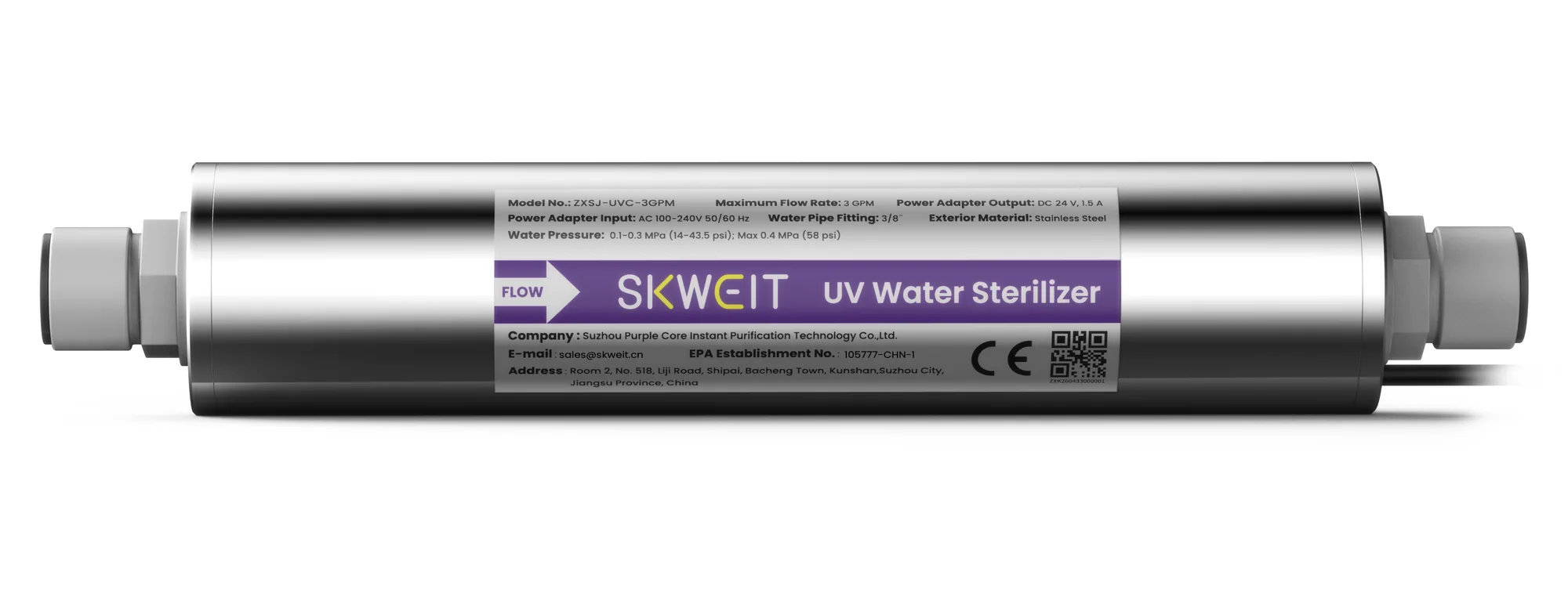
- Models: ZXSJ-UVC-1GPM (1 GPM / 4 LPM, 1/4") | ZXSJ-UVC-3GPM (3 GPM / 11.4 LPM, 3/8")
- Available now: instruction manual · parameter table · CE certificate DPCW/01068/06/KA/26 · EPA Establishment No. 105777-CHN-1
- Not held: a dose value, a transmittance value, a flow rating and any validated service life — this article sets out why we would rather state a limit than a figure without one
Send an enquiry
Typical response within one business day.
This form is not yet connected to a mail service — the enquiry endpoint will be wired up when it is connected. Until then, enquiries reach the manufacturer through the contact page.
Sources and scope
4 sources
- This article is a procurement methodology. The ten questions are the manufacturer's own and are offered as a way of establishing conditions that are otherwise left unstated; they are not drawn from, and do not represent, any industry standard, certification scheme or trade body's guidance.
- The distinction between a facility registration and a product certification, used in question 1, is set out at length in the article linked above on reading a supplier's certificate. The conditions behind a dose figure and the role of transmittance in a rating, used in questions 4 and 5, link to the two articles named in the text.
- Deliberately not published: any dose value, transmittance value, flow rating, validated service life, or certified performance figure for any product. This page draws no comparison between suppliers and names none.
- Commercial terms referenced in questions 8 to 10 are those of the applicable contract and documents. Where this site's own position on a document or a parameter is relevant, the corresponding page is named in the text rather than summarised here, because a specification has to be a single source rather than one of several.