The sleeve is an optical component: why quartz sits between the lamp and the water
A lamp that emits ultraviolet cannot be immersed in drinking water bare. Something has to stand between the two, and it has to do three jobs at once: keep electricity out of the water, keep water off a hot lamp, and let the light through. That third job is the one that disappears from a specification sheet, because it is reported as a material rather than as a performance figure. The consequence is simple and often missed: the sleeve is part of the light path, so the material it is made from decides how much of the light the water ever receives. Ordinary glass absorbs strongly at the wavelength an ultraviolet disinfection lamp produces; fused quartz does not. That single difference is why the part is quartz and not glass, and why “the lamp still glows” says nothing about what arrives.
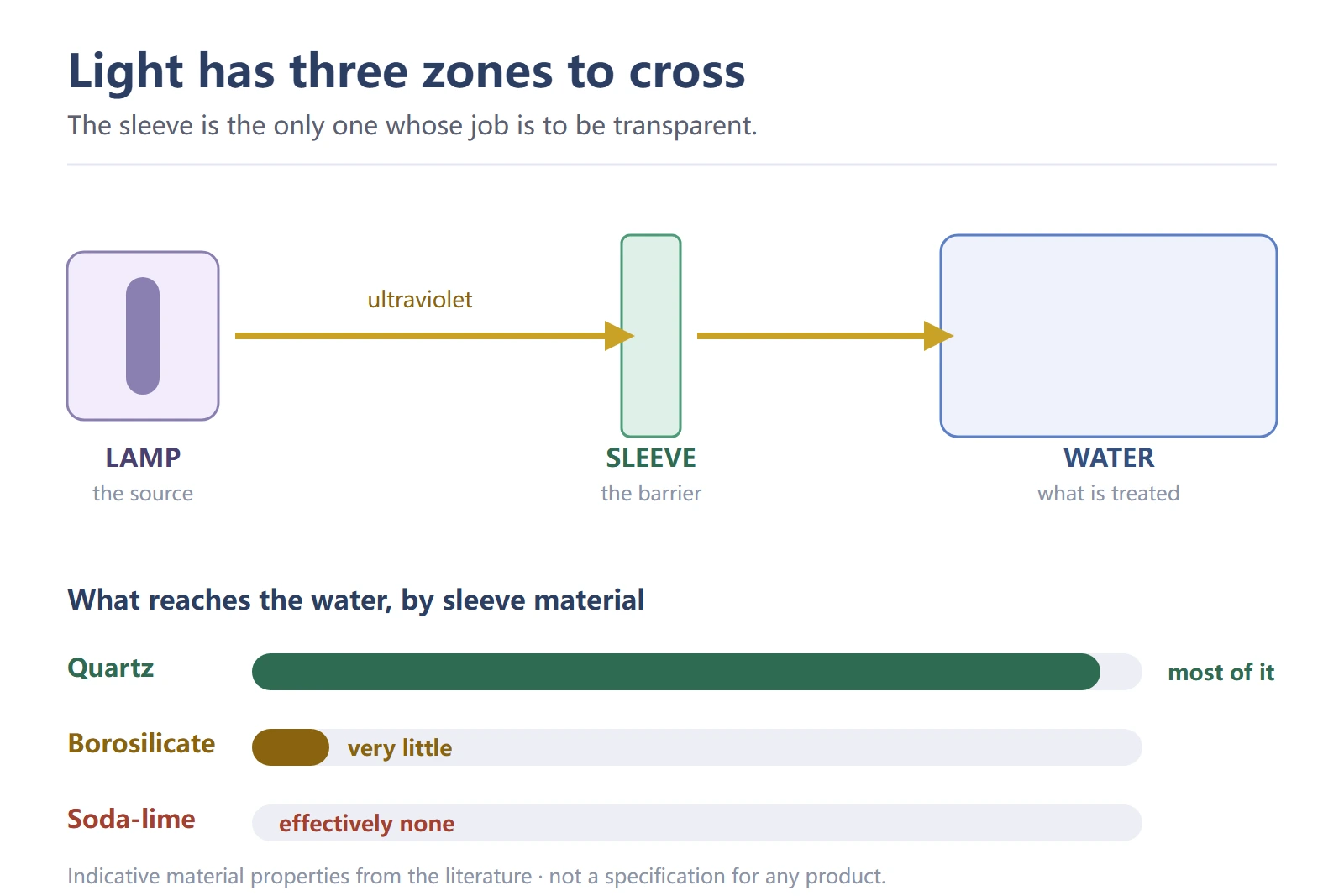
Three jobs, one of them invisible
A quartz sleeve is an unglamorous part: a closed tube of glass-like material, open at one end or fitted with a cap, into which the lamp slides. It is usually the cheapest item on the parts list and it does three separate things. Naming them separately is worthwhile because only two of the three appear anywhere in a technical discussion.
Isolation. Electricity and drinking water are kept apart. The lamp runs at a voltage that must not reach the water, and the sleeve is the wall that keeps it out. This duty is about the housing, the seals and the end fittings as much as about the tube, and it is the reason the sleeve is one of the parts whose condition is part of electrical safety rather than only part of performance.
Thermal separation. An operating lamp is hot, sometimes hot enough to matter to the materials around it. The sleeve holds a gap of air or gas between the lamp and the water, and the water on the outside carries heat away. This duty explains why the sleeve has to survive a temperature difference across a thin wall, and why a hairline crack usually begins at an end rather than in the middle of a tube.
Transmission. The light has to get out. This is the duty that is a property of the material rather than of the assembly, and it is the one that is almost never written on a data sheet. A sleeve that isolates perfectly and transmits nothing is a working electrical barrier attached to a treatment stage that does nothing at all.
Only the third of these is invisible in the ordinary sense: it cannot be seen, it cannot be felt, and it produces no indication on any controller. A fouled or scaled sleeve at least leaves a deposit you can find, as the companion article on quartz sleeve fouling sets out. A sleeve made from the wrong material leaves nothing at all.
254 nm is not “light” in the ordinary sense
Glass is described as transparent, and in ordinary life it is. That description is tied to the wavelengths the eye responds to — roughly 380 to 700 nanometres. Move below that range and ordinary glass stops behaving like a window. It is not that it becomes slightly less clear; it becomes, at some wavelength, effectively a wall.
The wavelength used by low-pressure ultraviolet disinfection lamps is around 254 nm, which sits well below the visible range. Different families of glass have their transmission limit at different places, and for the common glasses the limit falls above 254 nm — meaning the wavelength used for treatment is on the wrong side of it. This is a property of the material, not of its thickness or its quality: making the wall thinner does not move the limit, it only shortens the distance over which the absorption happens.
The figure below sets out the idea rather than a set of numbers. It is a comparison of material families, and it is drawn to show the order of the difference rather than a measured value — the point being that the gap between the right material and the plausible-looking alternative is not a matter of a few per cent.
Two practical consequences follow from that. The first is that a transparent-looking part can be the wrong part: clarity to the eye is evidence about the visible range and about nothing else. The second is that the question worth asking about a sleeve is not “is it glass?” — it is the name of the material and, where the answer is a quartz, which grade of it.
Where the materials differ, and where they do not
The materials that appear in this role are a short list, and it is worth setting out what each is good at, because the trade-offs are not what an untrained reading of the word “glass” would suggest.
Fused quartz, also called fused silica. Made by melting a high-purity silica source rather than by combining the mixture of oxides that ordinary glass contains, it transmits the treatment wavelength well and survives the temperature step across the wall. The distinctions within this family matter — grades differ in how much hydroxyl is present and in how they behave under prolonged ultraviolet exposure, and a sleeve is normally specified by grade rather than by the word “quartz” alone. It is also the more expensive material and the more difficult to form, which is exactly why the cheaper alternatives keep being proposed.
Borosilicate glass. The laboratory glassware family, valued for low thermal expansion and chemical resistance. Its transmission limit sits above the treatment wavelength, which makes it a poor optical choice for this role however good a material it is for others. A borosilicate sleeve can be a perfectly sound mechanical and electrical barrier and still be almost useless for the purpose the stage exists for.
Soda-lime glass. The window-glass and bottle-glass family. Cheap, easy to form and its limit sits furthest into the visible range of the three, which puts the treatment wavelength well outside what it passes. It appears in this discussion mainly as the material a part is assumed to be when “glass” is written without a qualifier.
Fluoropolymers. Some fluorinated plastics transmit the treatment wavelength usefully and are used in other ultraviolet applications, and they are the reason a sleeve statement limited to “glass” is incomplete. Their limits lie elsewhere: they are softer, they have their own temperature ceilings, and their use in a pressurised housing brings the end fittings back into the design. A different material is not automatically a worse one — it is a different set of trade-offs, and the trade-off has to be stated rather than assumed.
Where the list does not differ is worth saying too. Thickness, surface finish and wall quality affect how much light is lost by reflection and scattering, but they do not relocate a material's transmission limit. A thick quartz sleeve and a thin one are both quartz and both pass the treatment wavelength; a thin borosilicate sleeve is still borosilicate. Thickness is a question about how much, the material is a question about whether at all — and the second question comes first.
Even a correct sleeve takes something away
Quartz is the right material; it is not a perfect window. Two mechanisms remove light on the way to the water, and both are ordinary rather than faults.
Reflection at the surfaces. Any interface between two media reflects a fraction of the light arriving at it, and a sleeve presents two such interfaces — air or gas to quartz on the inside, quartz to water on the outside. Some of what leaves the lamp turns back at the first surface and again at the second. This is a standing property of the design rather than a defect, and it is one of the reasons a treatment stage is not designed by counting photons at the lamp.
What accumulates on the surfaces. The outer surface is in contact with the water being treated, and the water is not inert. Hardness, alkalinity and temperature together decide whether the water tends to deposit a mineral film, and any film sits directly in the light path. This is a fouling question rather than a materials question, and it has its own article: why a fouled sleeve produces no indication at all. What matters here is the ordering — the material question decides whether light can pass, and the fouling question decides how much of it still does six months later. Both have to be answered, and neither substitutes for the other.
There is a third, less obvious subtraction, and it belongs to the water as much as to the sleeve. Ultraviolet is attenuated as it travels through water as well as through the wall, and the degree to which it is attenuated depends on the water in a particular installation. That is why a stage cannot be described by its parts alone, and why the article on water transmittance treats it as a design input rather than as a footnote. The sleeve and the water are two stages of the same journey, and the light has to survive both.
Reading a claim about a sleeve
Statements about sleeves appear in quotations, in catalogues and in drawings, and they vary a great deal in what they actually commit to. Four forms are worth telling apart, because they carry very different amounts of information.
“Quartz sleeve” and nothing else. This is a material name without a grade, and the grade is where the meaningful distinctions sit. It is not a false statement — it is an incomplete one, in the same way that “stainless steel” is incomplete without a designation.
A transmission figure with no wavelength. Transmission is a property of a material at a wavelength. A single percentage quoted without the wavelength it applies to cannot be checked against anything, because the same material has a different figure at every wavelength along its curve, and the curve falls steeply near the limit.
A transmission figure quoted for a specimen. The figure may be real and still not describe the part. Laboratory specimens are often thinner than a production sleeve, and sometimes measured across a polished flat rather than through the curved wall of a tube. Asking at what thickness the figure was taken resolves the question in one line.
A performance claim resting on the sleeve. The most consequential form, and the one that has to be read most carefully: a statement that the unit delivers some outcome, with the sleeve material offered as the evidence for it. The sleeve is one element of the light path — it sits alongside the source, the chamber geometry and the water itself. A statement about treatment has to account for all four, and this site's position on publishing a figure that would depend on conditions it has not measured is set out in what a dose figure means. The sleeve being quartz is a necessary condition; it is not the whole of the claim.
None of these distinctions requires a laboratory to apply. Each of them is a question that can be asked of the document in front of you, and each has an answer that can be written down — which is also the shape of the questions worth asking about a certificate or a registration.
A four-point check
Four questions settle whether the sleeve on a unit, or in a quotation, is doing the job its material is there to do. They are answerable from the document or from one short reply.
One — what is the material, by name? Not “glass”, and not “quartz” on its own if a grade is available. The answer decides whether the treatment wavelength can pass at all, before anything is measured or calculated.
Two — is any transmission figure given with its wavelength and its thickness? Both are needed for the figure to mean anything. A figure without its wavelength cannot be placed on a curve; a figure without its thickness cannot be transferred to the part.
Three — what separates the sleeve from the water on the outside? Nothing is the usual answer and the correct one for most in-line stages, which is precisely why the outer surface needs a maintenance answer. Ask what the cleaning interval is based on and whether it is written down somewhere the person servicing the unit will see it.
Four — can the sleeve be replaced on its own? A sleeve is a wear item, and the question is whether replacing it is a maintenance task or a reason to replace a housing. The answer shapes the whole-life cost of the stage far more than the price of the tube does.
A supplier who can answer the first two and not the second two is telling you something useful: you now know which parts of the design were specified and which were left to be discovered on site. That is a better outcome than four confident answers, because it tells you where to look.
Questions this article raises
Can ordinary glass be used if it is thin enough?
No — thickness changes how much light is absorbed over a given distance, not which wavelengths the material will pass at all. A material whose transmission limit sits above the treatment wavelength is absorbing at that wavelength whether the wall is two millimetres or half of one; making it thinner reduces the distance over which the absorption happens rather than removing the absorption. The direction of the answer is wrong before the magnitude is considered.
Why is the sleeve not simply left out and the lamp sealed into the housing?
Because a lamp has to be replaced, and replacement has to happen without opening the water side of the system. A sleeve makes the lamp a removable part held in a sealed, dry space, while the water stays on the other side of a barrier that is never broken during routine maintenance. Removing the sleeve would mean either breaching the water side at every lamp change or designing a lamp that can be sealed into a pressurised housing and still be replaced — a harder problem, and not one the sleeve exists to solve.
Does a cleaner-looking sleeve transmit more?
Clarity to the eye is not a measurement at the treatment wavelength. A part can look perfectly clear and still be the wrong material, and the eye cannot detect the difference because it is not sensitive to the wavelengths involved. What the eye can usefully assess is a visible film or deposit on the surface, which is a different question with its own article. Use the eye for what it can see, and ask for the material by name for what it cannot.
Does the sleeve material change over the life of the unit?
The material does not change; its surfaces can. Deposits, cleaning and handling all act on the surface, and a scratch or an etched patch scatters light that would otherwise have crossed. That is a reason to treat the sleeve as a replaceable part with its own maintenance answer, and a reason not to clean it with anything abrasive. It is not a reason to expect the material to lose its transmission limit, which is a property of its composition.
What material do the units on this site use?
The sleeve is fused quartz, and it is a replaceable part. No transmission figure for it is published here, for the same reason no dose figure is: a percentage without the wavelength and the specimen thickness it was measured at cannot be checked by the reader, and publishing it in that form would make it look more portable than it is. The document set that is available for the models this site sells is collected on the data sheet page, and the reasoning behind what is and is not published is set out on the article on dose figures.
Send the sleeve statement you are working from
If a data sheet, a drawing or a quotation describes the sleeve on a unit you are evaluating, send the wording as written — the material name, any transmission figure with its wavelength, and the maintenance answer if there is one. We will tell you which of the four checks above it answers, which it leaves open, and what the missing information would have to be before two sleeves can be compared.
- Models: ZXSJ-UVC-1GPM (1 GPM / 4 LPM, 1/4") | ZXSJ-UVC-3GPM (3 GPM / 11.4 LPM, 3/8")
- Available now: instruction manual · parameter table · CE certificate DPCW/01068/06/KA/26 · EPA Establishment No. 105777-CHN-1
- Not published: a transmission figure for the sleeve, a contact time, a dose value, an irradiance value and any validated service life — this article sets out why a transmission figure without its wavelength and thickness is not yet a figure
Send an enquiry
Typical response within one business day.
This form is not yet connected to a mail service — the enquiry endpoint will be wired up when it is connected. Until then, enquiries reach the manufacturer through the contact page.
Sources and scope
4 sources
- The description of sleeve duties follows ordinary practice for lamp-in-sleeve ultraviolet treatment stages: the sleeve provides electrical isolation between the lamp and the water, holds a gas gap against the lamp’s operating temperature and forms the optical window through which the light reaches the water. Where a sleeve is described in a document, the material name and grade, rather than the word “glass”, are what identify it.
- The transmission limits shown in the diagram are typical values for each material family as reported in optical materials literature. They are drawn to illustrate the order of the difference between families and are not measurements of any product; nor do they substitute for a transmission figure taken at a stated wavelength and specimen thickness.
- Deliberately not published: any transmission figure, contact time, dose value, irradiance value or validated service life for any product. Where a number would have to come from a measurement the manufacturer has not run on a stated specimen and at a stated wavelength, no number appears here.
- The sleeve is a replaceable part. This article describes the role the material plays in the light path; it is not a specification for any installation and it does not state what any given unit delivers. The fouling of a sleeve in service is treated separately, as are the water conditions that decide whether a stage is correctly sized for a particular supply.