Scale forms before the sleeve shows it: three signals to read first
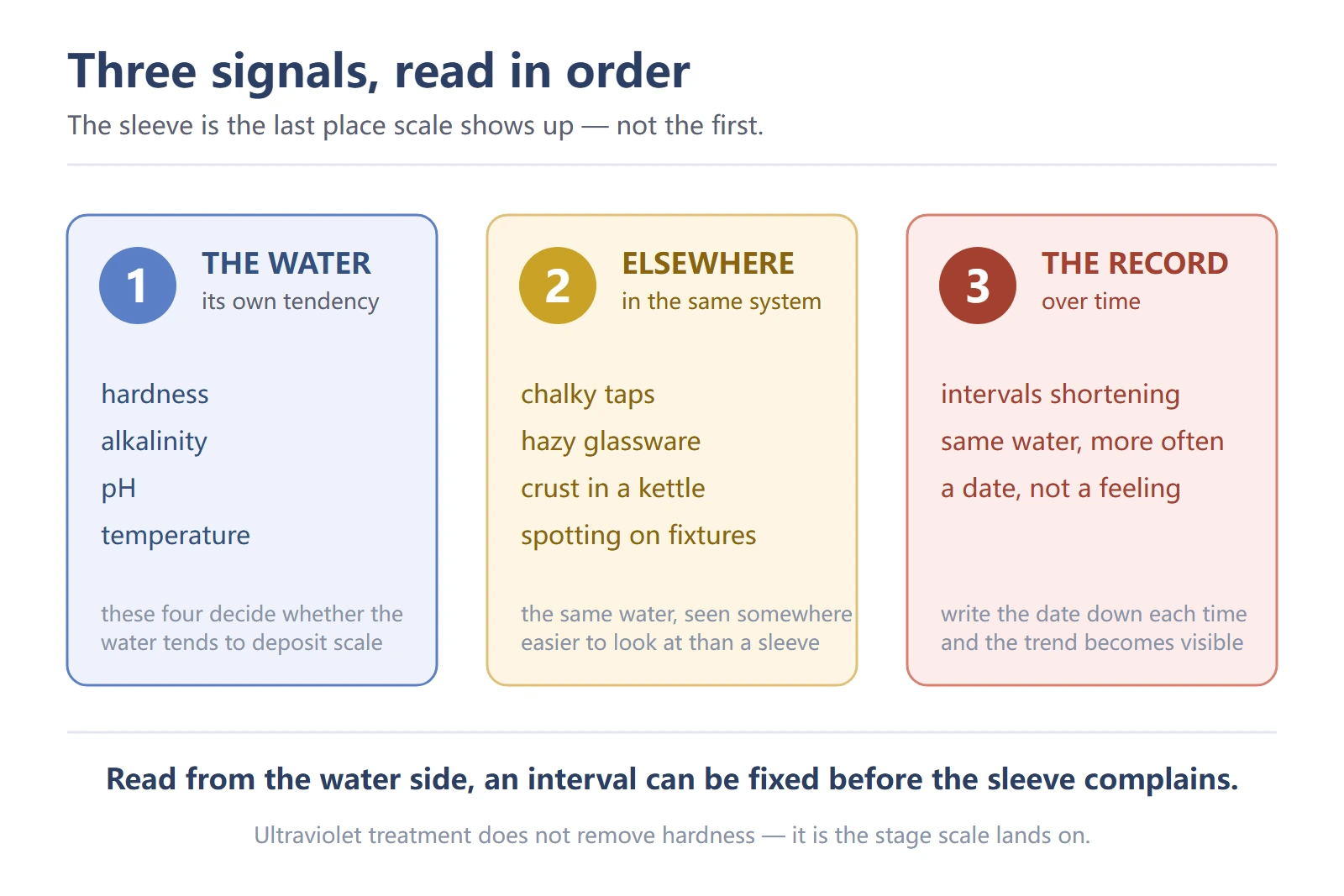
A mineral film on the sleeve is the last stage of a process that started in the water. By the time it is visible, the water has been telling you for months — in its own chemistry, in what it leaves behind elsewhere in the same building, and in the maintenance record. Three signals carry that information, and all three are readable before anything has to be opened. What they have in common is that none of them requires looking at the treatment stage at all: they are read from the water side. That matters because the stage itself is the worst place to look — as the companion article on sleeve fouling sets out, a film in the light path produces no indication, no noise and no change in flow. Ultraviolet treatment also does not remove hardness, so nothing inside the unit is working against the deposit: the only useful moment to act is before it forms.
Hard water is a property of the water, not a fault in the unit
“Hard water” describes water carrying dissolved minerals, principally calcium and magnesium, picked up as it moves through rock and soil. It is a description of the supply, not a judgement about it, and it is not something a treatment stage can change. This is worth stating plainly at the start, because the failure mode being discussed here is regularly read as a fault in the equipment rather than as a property of what is being treated.
Ultraviolet treatment does not soften water. Light at the treatment wavelength acts on what is in the water in a specific way, and dissolved calcium and magnesium are not part of it. Nothing about an ultraviolet stage removes hardness, exchanges ions or changes the water's tendency to deposit a film. The stage is downstream of the problem, not a treatment for it — and that is exactly why the deposit shows up there.
Whether a water deposits scale is a question with several inputs. Hardness is the one usually named, but it acts together with alkalinity, pH and temperature. Water can be hard and remain well behaved if the other conditions keep the minerals dissolved; water that is moderately hard can deposit readily where the temperature is high or the pH favours it. This is the reason a single hardness number, read on its own, does not settle the question — and why the first signal below is a group of values rather than one.
A deposit is not a defect in the stage. The stage is doing what it can with the water it is given. What the three signals below allow is not a repair but a decision: how often the part that collects the film needs attention, made in advance rather than after the fact.
What the water is made of
The first signal is the chemistry of the supply, and it is available before the equipment is installed. Four values carry most of it, and a water report or a single test usually provides all four.
Hardness. The concentration of dissolved calcium and magnesium, reported variously as mg/L of calcium carbonate equivalent or in grains per gallon. It sets how much mineral is available to come out of solution. It does not on its own decide that it will.
Alkalinity. The water's capacity to resist a change in pH, and in scale terms the partner of hardness. The pair matters more than either alone: scale formation depends on the relationship between the two, which is why a water report that gives only hardness is an incomplete answer to the question being asked here.
pH. The position on the acid–base scale, and the value that decides which way the equilibrium leans. Higher pH shifts a carbonate system towards the form that deposits. It is also the easiest of the four to move, which is why it is a common target of upstream treatment rather than of anything done at the stage.
Temperature. The fourth input, and the one that most often gets left out of the conversation. Many minerals are less soluble in warm water than in cold, so heating a supply moves it towards depositing — the same mechanism behind the furring inside a kettle or a hot-water cylinder, and the reason a stage on a warm line behaves differently from the same stage on a cold one. The four values together describe a tendency; none of them alone describes it.
A saturation index is one way of combining the four into a single number, and where one is available it is useful as a summary. It has limits worth knowing about, though. It is an equilibrium calculation, so it describes the water as analysed and not the water as it moves through a building; and it says nothing about how long a surface has to be wet or how rough it is. A convenient index is a summary of the four values, not a replacement for them.
What the water leaves behind elsewhere
The second signal is free to read, requires no instrument, and is almost always overlooked: the same water is already in contact with surfaces all over the building, and those surfaces report what it does. Looking at them takes a walk rather than a measurement.
Where to look, in order of how quickly a film shows. Surfaces that are wet and then dry are the most informative, because a film that would stay invisible under water becomes visible when it dries. Aerator screens and tap spouts collect and show it. Glassware that has been rinsed and left to dry shows a haze or a spotted residue. A kettle or a hot-water appliance shows it most of all, because heat drives the equilibrium towards depositing — the same mechanism that makes it relevant to a warm line. Shower heads, inside a toilet cistern and the base of a dishwasher or washing machine are all surfaces of the same kind.
What to look for. A chalky or white film that wipes off and leaves a mark; hardness spots on glass that resist a normal wash; a crust that is rough rather than smooth. The point is not to grade them but to establish that the water deposits something, somewhere, which converts the chemistry above from a possibility into an observation.
Why this signal is worth more than it looks. A film on a sleeve is difficult to see without dismantling the unit, and impossible to see without knowing what to compare it to. The deposit on a kettle is the same phenomenon with the light left out. Reading it somewhere easy turns an inspection interval from a guess into a decision, and it gives whoever maintains the stage a concrete reason to look when they otherwise would not.
What is on a sleeve once it has fouled — and how to tell a film apart from a lamp that is failing — is a different question, and it is dealt with in the companion article on sleeve fouling. The signals here are the ones that arrive before that point.
An interval that keeps getting shorter
The third signal exists only if someone wrote something down, and that is what makes it the most useful of the three — and the one most often missing. It is the record of how often the sleeve has needed attention, kept as dates rather than as impressions.
Why a single interval says very little. A cleaning every six months is not by itself good news or bad news. It may be a well-designed installation on a stable supply, or the first entry in a series that will shorten. One number has no direction to it. A short series does: six months, then four, then three is a trend, and it is visible long before the intervals become inconvenient.
How to keep it so that it is readable. Two entries are enough to start: the date the part was attended to, and what was found when it was. Both are one line, written on the unit or in whatever log the site already keeps. Nothing about this requires a new system, and the value comes entirely from the dates being real rather than recalled — the difference between “about twice a year” and a column of dates is the difference between a feeling and a signal.
What the trend is telling you. An interval that shortens while nothing else has changed says that the conditions producing the deposit have become more favourable to it, or that the interval was never matched to the water in the first place. Either way the useful output is the same: a decision about how often to attend to the part, taken from the record rather than from a general recommendation written for water that may not resemble yours.
Why the film ends up mattering where it does
The three signals describe a water that deposits minerals on surfaces. In most of a building that is an inconvenience. In an ultraviolet treatment stage it is something more specific, because of where the deposit lands.
The outer surface of the sleeve sits directly in the light path. Light has to leave the source, cross the sleeve wall and reach the water before it does anything at all — and a film on the outside of that wall intercepts it at the last moment before it would have arrived. The film does not need to be thick to matter, and its effect is not a reduction that announces itself: it reduces what the stage accomplishes while leaving every outward indication unchanged.
Two comparisons make the point concretely. A deposit on the chamber wall or on the housing has a different effect from a deposit on the sleeve, because the sleeve is the one surface every ray has to cross to reach the water. And the same film on a surface with no light passing through it is merely untidy. What makes the sleeve the place to watch is not that it fouls more readily than anything else — it is that it is the last surface before the light arrives.
That is also why the reading order in this article is deliberate. The chemistry tells you whether the water tends to deposit; the deposits elsewhere tell you that it does; the interval record tells you how fast. Read in that order, the third one can be set from evidence rather than from a recommendation written for a different supply. Read in the other order — starting at the stage — the first two are usually discovered too late to be useful, which is the situation the companion article is written to address.
What to do with the three signals
The signals are only worth collecting if they change something. Four things follow from them, in the order they become available.
Before installation — get the four values. Hardness, alkalinity, pH and the temperature of the line the stage will sit on. If a full analysis is not available, these four are the ones to ask for, and a supplier working from them can say something useful about the interval. A request for “the water quality” usually returns a single hardness figure, which is one of the four.
At installation — establish the baseline. Note the condition of the sleeve when it is new, and the date. That entry is what every later comparison is measured against, and it costs a sentence.
In service — keep the dates, not the impressions. Attending to the part is already happening; writing down when and what was found is the whole of the additional effort. Where a site already keeps a maintenance log, this is one line in it.
When the trend shortens — act upstream, not at the stage. The stage cannot change the water, so the levers are all on the supply side: softening, dosing, blending, or temperature control. Which of those is appropriate is a water-treatment question for the site and not something a stage can answer, and the useful contribution a stage's record makes is the evidence that some upstream measure is needed at all.
Underneath the four steps is a single idea, and it is the same one that governs how a specification should be read in general: a figure means something when its conditions travel with it. An interval quoted for water that resembles yours is useful; an interval quoted without the water is a number that happened somewhere else. The same reasoning is set out for transmittance and for dose figures, and it is why the parts of a specification that depend on the water are the parts most worth asking about.
Questions this article raises
Does an ultraviolet stage remove hardness from the water?
No. Ultraviolet treatment acts on what is in the water in a specific way and dissolved calcium and magnesium are not part of it. Hardness is unchanged by the stage, and so is the water's tendency to deposit a film. This is the reason the deposit appears on the parts of the stage that are in contact with water rather than being dealt with inside it, and the reason the useful action is upstream of the stage or in the maintenance schedule.
Is there one figure that tells me whether my water will scale?
There are convenient summaries — saturation indices combine several values into one number — and they are useful as a shorthand. They are not a substitute for the values, for two reasons. They describe a water in equilibrium, while water in a building is moving, being heated and being mixed; and they say nothing about the surfaces involved. Read as a summary of hardness, alkalinity, pH and temperature, an index is helpful. Read as a verdict on a supply, it is doing more work than it can support.
How often should the sleeve be cleaned?
There is no single answer that applies across supplies, and any figure quoted without the water it was established in is a number from somewhere else. What can be said is that the interval should come from the three signals in this article — the chemistry, the deposits seen elsewhere and the record of intervals so far — rather than from a general recommendation. A site that keeps dates will reach a defensible interval in one or two cycles.
Softening the water upstream — does that settle the question?
It removes the largest input, which is often decisive, and it does not remove the others. Alkalinity, pH and temperature still act on whatever remains in solution, and a softened supply on a hot line can still deposit. It is also a change to the water that the stage downstream sees, which is worth recording alongside the maintenance dates so that a change in interval can be attributed to something. Whether to soften is a water-treatment decision for the site, made on the site's water.
What does an in-line stage do about a scale-forming supply?
It treats the water that reaches it, and it collects a film while doing so. Because that film sits in the light path, the interval matters to the stage in a way it would not on a surface with no light crossing it. The models this site sells are in-line ultraviolet post-treatment stages for reverse-osmosis and under-sink installations; they are not water softeners and are not presented as treatment for hardness. The documents available for them are collected on the data sheet page, and the parts that depend on the water are the ones worth asking about before an installation is specified.
Send the water values and the interval question stops being a guess
If you have hardness, alkalinity, pH and the temperature of the line, send them as reported — with the units and the source of the figures. We will tell you which of the three signals above they answer, what the deposit you have seen elsewhere adds to the picture, and what a maintenance interval would need to be based on for that supply.
- Models: ZXSJ-UVC-1GPM (1 GPM / 4 LPM, 1/4") | ZXSJ-UVC-3GPM (3 GPM / 11.4 LPM, 3/8")
- Available now: instruction manual · parameter table · CE certificate DPCW/01068/06/KA/26 · EPA Establishment No. 105777-CHN-1
- Not published: a dose value, an irradiance value, a transmittance value, any validated service life and any cleaning interval for a supply we have not seen — this article sets out why an interval has to come from the water
Send an enquiry
Typical response within one business day.
This form is not yet connected to a mail service — the enquiry endpoint will be wired up when it is connected. Until then, enquiries reach the manufacturer through the contact page.
Sources and scope
4 sources
- Hardness is described here as the concentration of dissolved calcium and magnesium in a supply, reported as a calcium carbonate equivalent or in grains per gallon. Scale formation is described as the precipitation of sparingly soluble mineral species from water, a process whose likelihood depends on hardness together with alkalinity, pH and temperature rather than on any one of them. Saturation indices are treated as summaries of those values, calculated for the water as analysed.
- The deposit seen on taps, glassware, kettles and hot-water appliances is the same phenomenon as a deposit on a sleeve, at a different surface and without the light path. It is described here as an observable indication that a supply deposits minerals, not as a measurement of that supply or as a prediction of any interval.
- Deliberately not published: any dose value, irradiance value, transmittance value, certified performance figure, validated service life or cleaning interval for any product. Where a figure would have to come from a measurement the manufacturer has not run on a specified water, no figure appears here.
- This article describes how to read three water-side signals and what follows from them. It is not a water-treatment recommendation, and it does not state what any unit removes from or does to a supply. Ultraviolet treatment does not soften water; softening, dosing and temperature control are upstream measures that belong to the site and its water-treatment supplier.