A flow rating says how much water passes — not how long any of it stayed
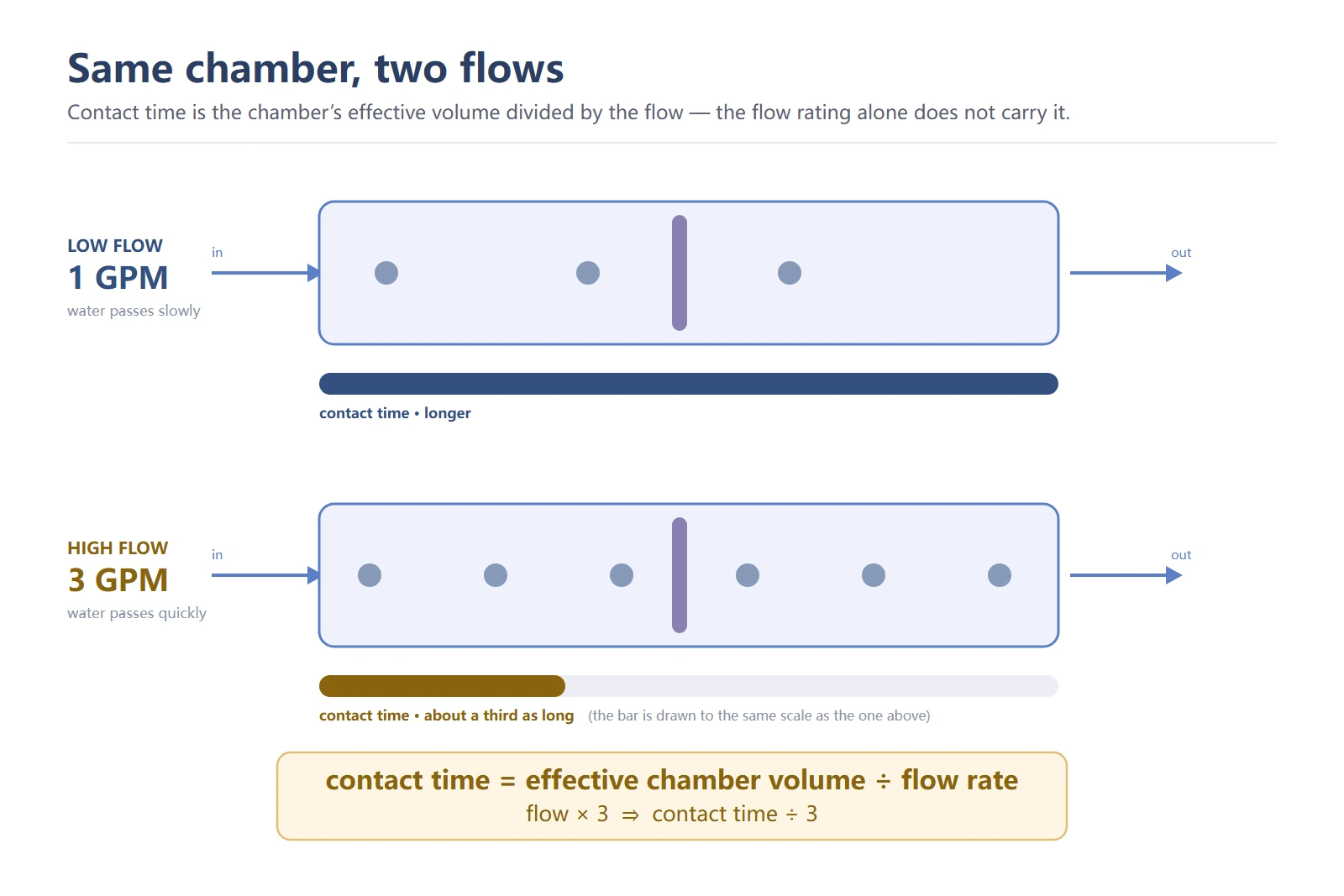
GPM is a flow rate: gallons passing a point every minute. Contact time is how long a parcel of water remains inside the treatment chamber — and it is not a property of the unit on its own, because it is a division: the chamber's effective volume divided by the flow. The same chamber carrying 1 GPM of water holds it for roughly three times as long as it does at 3 GPM. That is why a flow figure and a treatment figure are two different facts: the first is printed on a label, the second is the result of a calculation that uses it — and a label that gives you the first is not also giving you the second.
What a flow rating measures
A flow rate is a volume per unit of time. Gallons per minute is one way of writing that; litres per minute is the same quantity in different units. It answers a single question — how much water passes a given point in a minute — and it answers it well. It says nothing about where that water has been, what it met on the way, or how long it took.
Two conversions are worth holding, because they appear in almost every document and they are not interchangeable. One US gallon is about 3.785 litres, so 1 GPM is about 3.8 L/min and 3 GPM is about 11.4 L/min. One imperial gallon is about 4.546 litres, which makes an imperial gallon about twenty per cent larger. A document that says “gallons” without saying which gallon is not missing a detail — it is missing the value.
There is a second thing the figure is often read as saying and does not. A flow rating describes how much water passes through the unit, which is a statement about the plumbing it sits in. It is not a statement about how much water the system as a whole delivers — a system with a storage tank delivers water at whatever the tap and the pump allow, and the flow through an in-line stage in that system is a different number from the flow out of the faucet. Reading a flow rating as a delivery rate is a common and expensive confusion, and it is a good example of what a specification does and does not carry when a single number is read as though it were the whole of one.
Contact time is a division
Contact time — sometimes written as residence time, or hydraulic retention time — is how long water spends inside the part of the chamber that receives light. It is not measured on the label and it is not a separate feature. It falls out of two other quantities:
contact time = effective chamber volume ÷ flow rate
The word doing the most work in that equation is effective. A chamber's outside dimensions give its enclosed volume, which is not the same thing. The volume that counts is the part the water occupies while it is receiving light — the annulus around the source, the length of the irradiated path, the regions the flow actually reaches. Inlet and outlet fittings, headers, and any dead space at the ends of a housing are enclosed volume that contributes to nothing. When two units both quote a volume, the figure that matters is the effective one, and it is the figure less often stated.
Run the division once with assumed numbers and the order of magnitude becomes concrete. Suppose a chamber's effective volume is half a litre. At 1 GPM — 3.785 L/min — water spends about 7.9 seconds in the chamber. At 3 GPM — 11.36 L/min — the same chamber gives it about 2.6 seconds. Neither number is a specification for anything; they are here because a division is easier to trust once it has been performed once. What they show is the shape of the relationship: the chamber did not change, and the time water spent in it fell to a third.
Twice the flow, half the time — and where that stops being true
Within one chamber, the relationship is inverse and simple. Flow and contact time move in opposite directions by the same factor: double the flow and the time halves; halve the flow and the time doubles. This is worth stating plainly because it is the one part of this subject that can be reasoned about without any further information, and because it is regularly misread as a statement about performance. It is not. It is a statement about time.
The second thing worth saying is where the reasoning stops. A flow rating on its own does not tell you the contact time, because the volume is in the denominator of nothing and in the numerator of everything. Two units can both be rated at 3 GPM and give water very different amounts of time inside, if their effective volumes differ:
There is a third limit, and it is the one that turns a clean calculation into an estimate. The division gives the nominal contact time, which assumes every parcel of water spends the same time in the chamber — a plug of water moving through as a single body. Real flow does not do that. Water in the centre of a channel moves faster than water near the wall; some paths are shorter than others; corners and fittings create regions where flow is slow or nearly still. The result is a distribution of times rather than a single time, and the nominal figure is its convenient summary rather than its value.
This matters for the same reason the transmittance of the water matters: it is a condition the simplified arithmetic has assumed away. A nominal contact time is a legitimate engineering figure and it is how chambers are compared in practice — but it is a design estimate, and the difference between it and the time the slowest-travelling fraction of the water actually experiences is a matter of chamber geometry, and it is established by testing rather than by division.
What the flow rating does not carry
The phrase “a 3 GPM ultraviolet sterilizer” reads like a complete specification and is not one. It states one quantity and it is silent on the quantities that turn that one into a treatment claim. Set out plainly, a flow rating does not tell you:
The contact time. That is the division above, and it needs the volume, which the rating does not contain.
The effective chamber volume. The number that would let you do the division yourself. Where it is given, check whether it is the enclosed volume of the housing or the irradiated volume — the two differ, and only one of them belongs in the equation.
The irradiance. How strong the light field is, at the place and in the direction it is measured. This is a property of the source and the chamber together, and it is the other half of the treatment calculation — a power per unit area rather than an energy, and the quantity that the time then multiplies.
The dose, and the conditions it was established under. A dose is an irradiance acting for a time, and it is a property of a chamber, a flow and a water. The companion article explains why this site publishes no dose figure at all rather than publishing one without its conditions.
The water it applies to. Ultraviolet light is attenuated as it passes through water, so a chamber that delivers a given amount of energy in one water delivers less in another. The same unit, the same flow, two waters of different transmittance: two different results.
Whether the figure is a rating, a maximum or a test condition. These are three different statements. A rating is what the unit is designed to carry continuously; a maximum is a boundary that should not be crossed; a test condition is what a particular laboratory run used. Documents frequently present the third as though it were the first.
None of this makes the flow rating a bad number. It makes it an input — one of several, and the one most often promoted to a conclusion.
Sizing runs from the water backwards
The reason a flow rating cannot be read as an answer is that the reasoning that produces it runs the other way. In a correctly sized installation, the flow is not where the design starts — it is what the design is allowed to accept once everything else is settled. Read in the order it actually happens, the chain looks like this:
One — the water. What is upstream of the stage, and how much light the water lets through at the treatment wavelength. This is the condition that fixes how much energy has to be delivered over the available path, and it varies between installations that look identical from the outside.
Two — the objective. What the stage is there to do, expressed in terms of the treatment target rather than a product name. This is what the sizing is against.
Three — the energy requirement. The treatment target and the water together fix the amount of ultraviolet energy that has to reach the water, per unit of volume, under stated conditions.
Four — the chamber. The source, its output and the geometry of the chamber together determine the irradiance field and the length of the path water travels through it. This is where the effective volume is decided.
Five — and only now, the flow. With a chamber of that volume and a field of that strength, the flow is the rate that keeps each parcel of water in the field long enough. The rating is the output of the calculation, which is exactly why quoting it back at the start of the conversation does not reconstitute the calculation.
Two consequences follow. The first is that the same unit carries different flow ratings in different waters: lower transmittance means more attenuation along the path, which means more time or more intensity is needed, which means less water per minute through the same chamber. The second is that a flow rating without the water it was established in is not a rating the buyer can check — it is a number that happened in a laboratory and travelled alone. Where a figure this site publishes does depend on a condition, the condition is stated with it, and the available documents are collected on the data sheet page.
A five-point check for a flow figure
Any flow rating in a document can be made checkable by five questions, and all five are answerable from the document or from one short reply. They are worth asking in order, because the first two settle whether the figure can be read at all.
One — which gallon, and which unit? US or imperial, and gallons per minute or litres per minute. A US gallon is 3.785 litres and an imperial gallon is 4.546 litres, so the answer changes the number by about twenty per cent before anything else is considered.
Two — rated for which unit, at which connection size? A flow figure belongs to a model and a fitting. A rating quoted for a family of products, or for a body without the connection it will be installed with, is not yet attached to anything you can buy.
Three — what is the effective volume of the chamber? Without it, the contact time cannot be worked out and the flow figure stands alone. Ask specifically whether the volume given is the irradiated volume or the enclosed volume of the housing; where the answer is the latter, the contact time you compute from it will be an overestimate.
Four — at what water quality was that rated? Transmittance at the treatment wavelength, and the source of the figure. A rating established in laboratory water and applied to a well supply is a rating being used outside its conditions.
Five — is it a continuous rating or a maximum? The two should not be the same number, and the difference tells you how much headroom the design was given. Where the answer is “both”, the figure has not been established under a stated condition at all.
All five have the same shape as the questions worth asking about a certificate: each asks for a stated fact rather than an assurance, and each has an answer that can be written down — which is what reading a supplier's documentation amounts to in practice. A supplier who can answer three of them and not the other two is still telling you something useful: you now know which parts of the specification were measured and which were assumed.
Questions this article raises
Can I work out the treatment performance from a GPM rating?
No — not from the rating alone. The flow is one input to the calculation that produces a contact time, and the contact time is one input to the calculation that relates energy to effect. A flow rating with no chamber volume, no irradiance and no stated water supports the question how much water can pass, and nothing further. That is a useful answer; it is just not the one it is often taken to be.
Is a higher-flow unit always the stronger one?
It is the one that passes more water per minute, which is a statement about capacity. Whether it delivers more treatment depends on the chamber it passes through: a large chamber at a high flow can hold water longer than a small chamber at a low flow, and the two ratings alone do not tell you which is which. The comparison only becomes meaningful once the effective volume of each is known.
Why not simply state the contact time on the label?
Because it is not a property of the unit — it is a property of the unit running at a flow. A single printed figure would have to assume a flow rate, and the assumption would then be invisible to the reader who installs it at a different one. What can be stated without an assumption is the volume, and the flow rating at which the unit is designed to operate; the contact time follows from the two, at whatever flow is actually in use.
What happens if the flow is lower than the rating?
Contact time increases, because the divisor got smaller — and that is the direction that generally helps treatment. It is not automatically free. Very low flow can change the flow pattern inside the chamber rather than simply slowing it, and a system running far below its rated flow has usually been sized for something else. The useful conclusion is narrower: the inverse relationship is the reason flow control matters, and why an installation that varies its flow is not operating a constant.
Does this site publish a contact time or a flow rating?
The flow rating is published for each model, on the product pages, together with the connection size. No contact time and no dose figure is published for any model, because both are results of calculations whose other inputs include the water and the installation — and a figure published without those is a figure that looks more portable than it is. The reasoning is set out in the article on what a dose figure means.
Send the flow figure you are working from
If you are sizing a point-of-use or under-sink stage and have a flow figure from a data sheet, a drawing or a quotation, send it as written — the unit, the model and the water it is meant for. We will tell you which of the five checks above it answers, which it leaves open, and what the missing quantities would have to be before the rating can be compared with another.
- Models: ZXSJ-UVC-1GPM (1 GPM / 4 LPM, 1/4") | ZXSJ-UVC-3GPM (3 GPM / 11.4 LPM, 3/8")
- Available now: instruction manual · parameter table · CE certificate DPCW/01068/06/KA/26 · EPA Establishment No. 105777-CHN-1
- Not published: a contact time, a dose value, an irradiance value, a transmittance value and any validated service life — this article sets out why the first of these is a division rather than a label entry
Send an enquiry
Typical response within one business day.
This form is not yet connected to a mail service — the enquiry endpoint will be wired up when it is connected. Until then, enquiries reach the manufacturer through the contact page.
Sources and scope
4 sources
- The definitions used here follow ordinary hydraulic usage: flow rate is a volume per unit time, and contact time, or hydraulic retention time, is the nominal time a parcel of water spends in a defined volume, obtained as that volume divided by the flow. The nominal figure assumes plug flow, which real chambers do not exhibit; the distribution of residence times is a property of the chamber geometry and is established by testing, not by division.
- The worked example is illustrative arithmetic. The effective volume of half a litre and the two flow rates were chosen to make the division easy to follow; none of them is a value for any product, and none should be read as one. The same applies to the two units compared in the diagram, whose volumes are drawn to no scale.
- Deliberately not published: any contact time, dose value, irradiance value, transmittance value or certified performance figure for any product. Where a number would have to come from a measurement the manufacturer has not run on a specified water, no number appears here.
- Flow ratings for the models this site sells are published on the product pages together with the connection size. This article describes the relationship between a flow rating and a contact time; it is not a sizing calculation for a particular installation, and any such calculation depends on the water, the plumbing and the treatment objective in front of it.